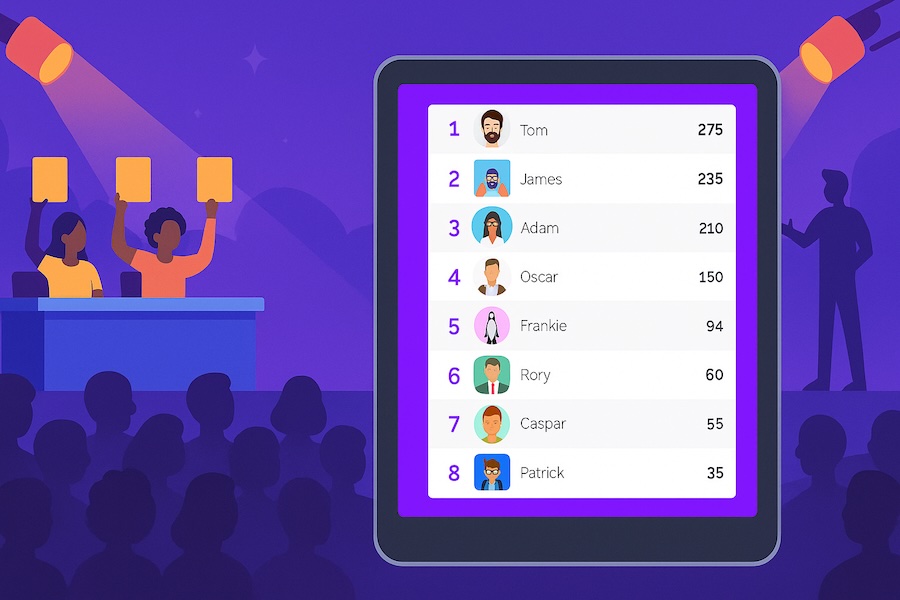
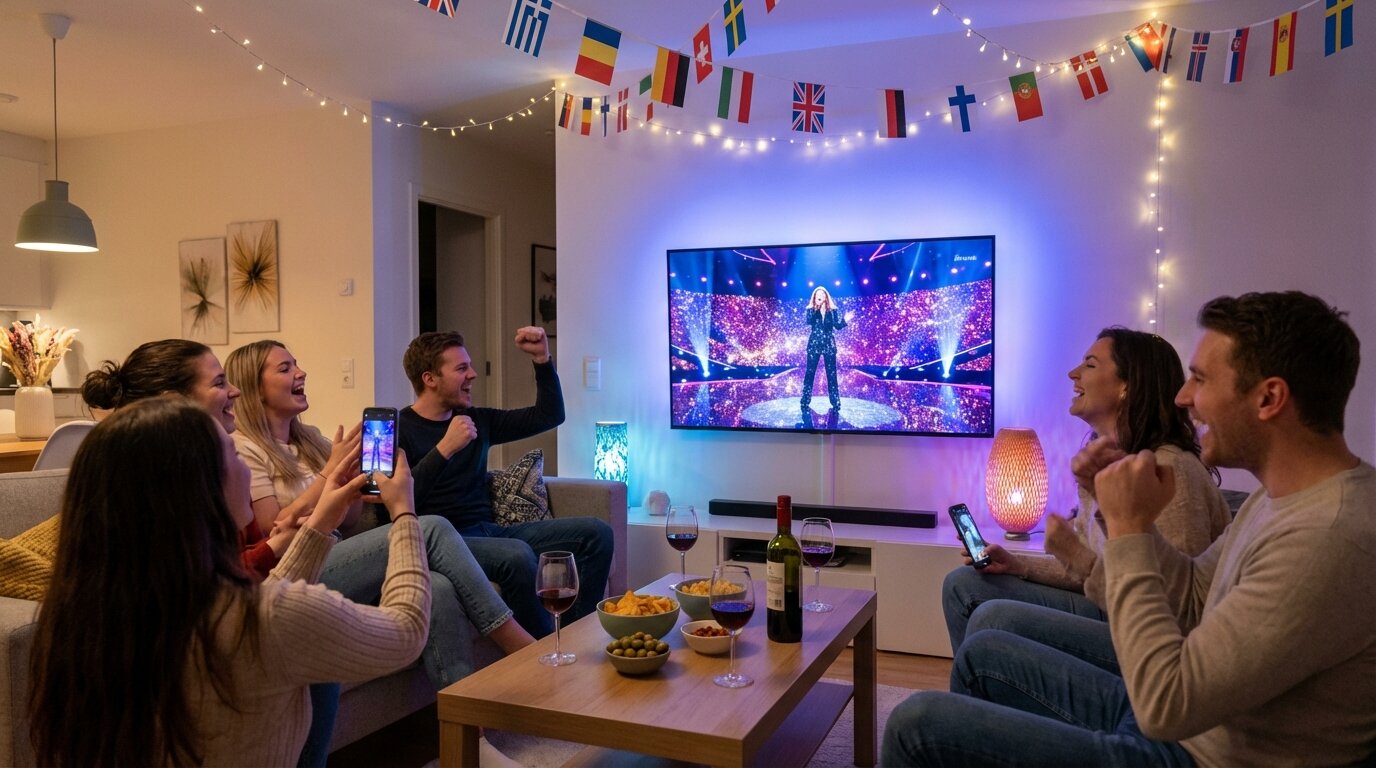
Eurovision parties are one of those rare events where everyone — the die-hard fans who've been tracking national selections since January and the friend who asks "wait, which one is Moldova?" — has a genuinely great time. The format does the work for you: big performances, voting drama, questionable staging choices that demand commentary.
But the difference between a good Eurovision party and an unforgettable one comes down to a few details. Here's everything you need.
Set Up Voting First (It Takes 2 Minutes)
Get this out of the way before your guests arrive. The single best thing you can do for your party is let everyone vote from their phone instead of shouting numbers at one person with a spreadsheet.
Here's how:
- Go to Score Judge and create a free competition
- Select Audience Voting mode
- Add the competing countries as entries
- Set your scoring criteria (one criterion like "Performance" works fine, or go multi-criteria with "Song", "Staging", "Outfit")
- Display the QR code on your TV between acts — guests scan it and vote
Everyone scores every act from their phone. Results update live on a public leaderboard you can display on the big screen. No app downloads, no sign-ups for your guests.
Set up Eurovision voting for your party →
Pro tip: Set up the competition the day before and test the voting link yourself. That way you're not fumbling with setup while the first act is already performing.
Food: One Dish Per Country
The best Eurovision party food strategy is simple: assign each guest a country and ask them to bring a dish from that nation. You'll end up with a table that looks like this:
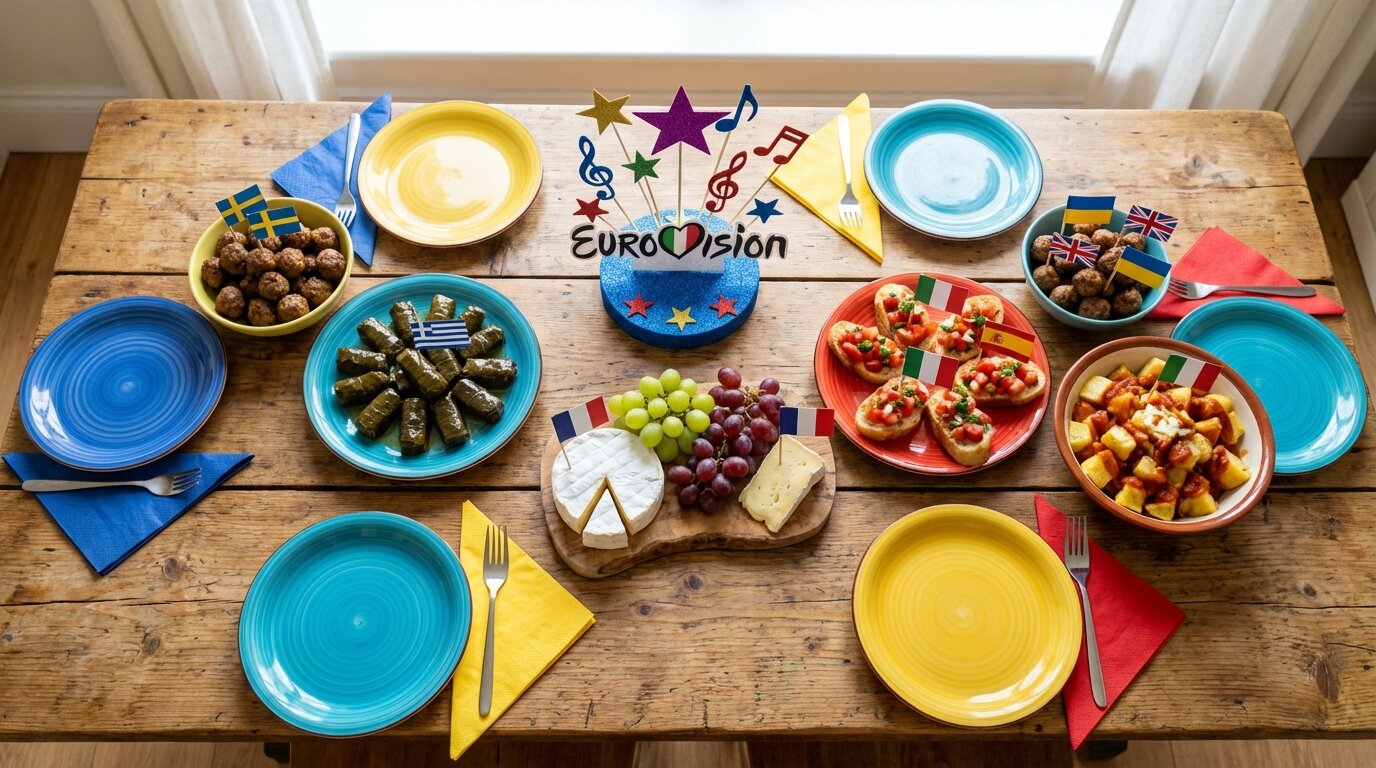
If you don't want to assign dishes, here's a quick shopping list that covers the continent:
Easy options you can buy ready-made
- Sweden: Meatballs (IKEA's frozen ones are fine — nobody's judging)
- France: Baguette + cheese board (brie, camembert, comté)
- Italy: Bruschetta or a caprese platter
- Spain: Olives, manchego, chorizo
- Greece: Hummus and pita, dolmades from the deli counter
- Germany: Pretzels and mustard
If you want to cook one thing
Make a big batch of one crowd-pleaser from the host country. Since ESC 2026 is in Basel, Switzerland, go with a fondue — it doubles as entertainment and conversation starter.
Drinks
- Wine from a competing country (cheap and thematic)
- The classic: one signature cocktail named after your favourite act
- Non-alcoholic: sparkling water with fruit, labelled as "12 Points Punch"
Decorations: Flags Are Everything
You don't need much. Eurovision decorations practically decorate themselves:
- Flag bunting — string small flags of all competing countries across the room. You can buy pre-made Eurovision flag sets online, or print your own
- Fairy lights — warm white or purple/blue for that Eurovision stage glow
- Score cards — print large numbers (1-12) on card stock. Guests hold them up after each performance for impromptu scoring
- Table flags — small country flags stuck into food dishes with cocktail sticks
- Ballot papers — if you're going old-school alongside the digital voting
The one rule: more is more. Eurovision is not the event for minimalist decor.
Costumes and Dress Code
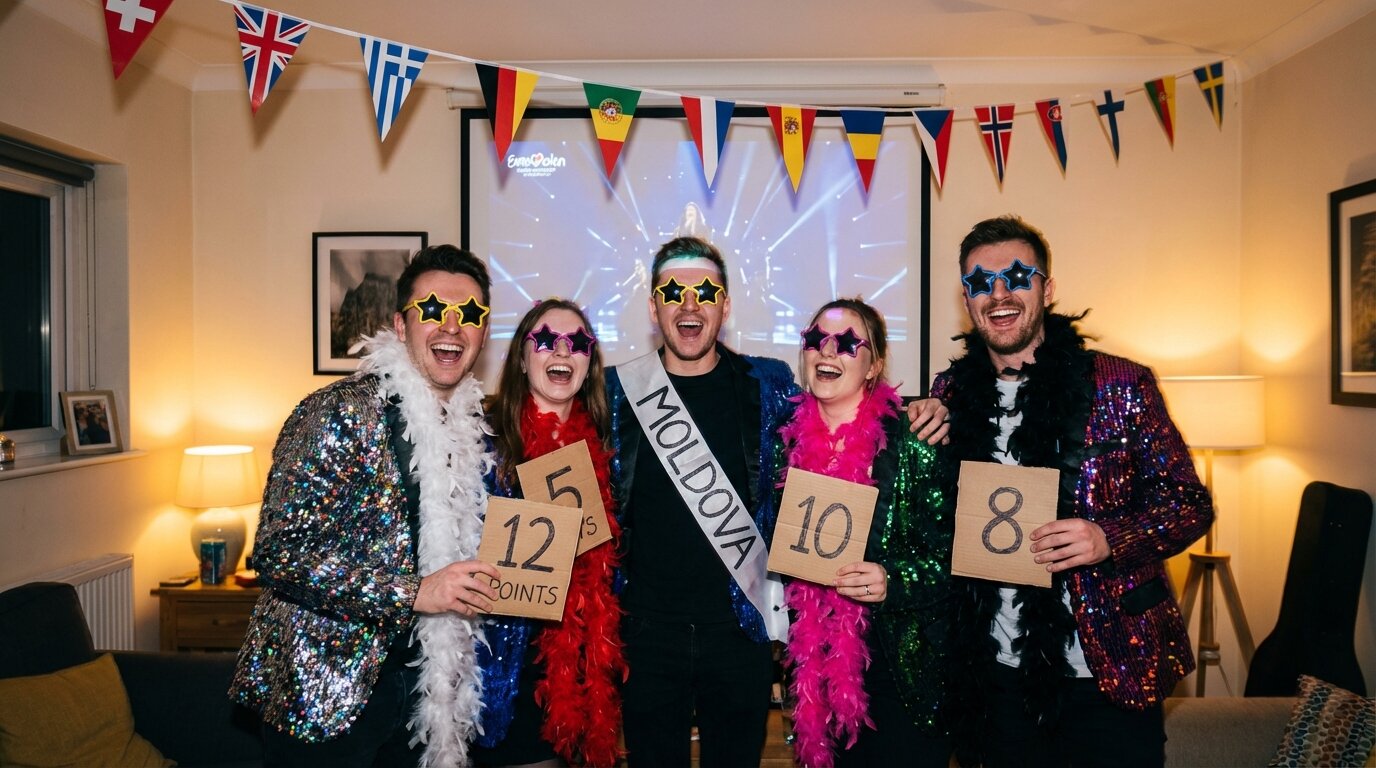
Three options, depending on how committed your friend group is:
Option 1: "Dress as a country"
Each guest picks a competing country and dresses to represent it. This ranges from "I wore a striped shirt for France" to full-costume territory. Works best when you assign countries in advance.
Option 2: "Eurovision glam"
Simple dress code: sparkle. Sequins, glitter, metallics, feather boas, star-shaped sunglasses. The key is that everyone is slightly overdressed for a living room.
Option 3: "Come as your favourite act"
Best for groups of die-hard fans. Everyone comes as their favourite Eurovision act of all time. Expect at least one ABBA and one Conchita Wurst.
Games and Activities
The drinking game
A Eurovision drinking game is practically mandatory. Here are the reliable rules:
- Sip when: a wind machine appears, someone does an unnecessary key change, the UK gets nil points, a performer removes a layer of clothing
- Drink when: pyrotechnics malfunction, the interval act is baffling, someone votes for their neighbour
- Finish your drink when: the greenroom camera catches someone looking devastated
Bingo
Print Eurovision bingo cards with squares like "barefoot performance", "prop violin", "dramatic cape removal", "surprise rapper". First to complete a row wins.
Prediction contest
Before the show starts, everyone writes down their top 3 prediction on paper (or in Score Judge). Closest to the actual result wins a prize. The prediction element keeps people invested even in the songs they don't love.
On the Night: Running Order
Before the show
- Get the food out and drinks poured
- Display the QR code for voting on the TV during the pre-show
- Hand out printed score cards for the analogue voters
- Brief the "wait, what is Eurovision?" guests on the basics: voting system, how points work, what douze points means
During performances
- After each act, give everyone 60 seconds to vote on their phone
- Display the live leaderboard between acts (Score Judge auto-updates)
- Read out the current standings every 10 acts or so to build tension
After the final act
- Close voting in Score Judge (finalize the competition)
- Reveal your party's results on the big screen alongside the official broadcast results
- Compare: did your party agree with the juries? The televote? Neither?
The Most Important Rule
Don't take it seriously. The whole point of Eurovision is that it's gloriously, unapologetically extra. The best parties lean into that energy — bad accents during the voting, passionate arguments about staging, genuine emotional investment in a song you'd never listen to outside this context.
Set up the voting, put out the food, hang the flags. Eurovision does the rest.