You're researching Judgify, you've read the pricing page, and the $699 per-event fee plus onboarding is bigger than you expected. Or your judges have asked why they need a Judgify account just to score a Friday-evening talent show. Or the live leaderboard you imagined on the auditorium screen isn't actually what Judgify is built to produce. Whichever brought you here — the market has more options than it did a few years ago, and they sit at very different price points.
What Judgify Actually Is
Judgify is a Singapore-based award management platform, founded in 2009 — the oldest product in this category. It's built around the full lifecycle of a contest or award program: a custom submission form, contestants uploading entries (PDFs, videos, audio), moderation by the organizer, one or more private judging rounds, and a final report. For programs with formal submissions and a deliberate evaluation process, this is the shape of work Judgify is purpose-built for.
The free Basic plan is real — 100 submissions, 5 categories, 1 private judging round, 5 MB file uploads. The paid plans step up sharply: Pro is $699 per event plus an onboarding fee, with 500 submissions, 25 categories, 5 judging rounds, and 50 MB file uploads. Pro Unlimited is $2,399/year plus onboarding and covers unlimited events at Pro specs. Enterprise is custom priced with unlimited categories and 250 MB file uploads. Onboarding support is bundled into the paid tiers — Judgify is sales-touch, not pure self-serve.
When Judgify makes sense: a corporate award program with nominations and moderated entries, an academic call for papers with abstract uploads, a creative contest with media files, or any event with multiple formal judging rounds (shortlist, semifinal, final) inside one workflow. If that describes the event you're running, Judgify is a deliberate, mature choice. The per-event price is part of a product genuinely doing more work — submissions, moderation, multi-round judging, file storage, and reporting — and you get an onboarding session as part of it.
When Judgify doesn't fit: a single live judging evening, a hackathon weekend where the audience watches teams pitch in real time, a school talent show run by a PTA, or any event where the judging is the show. The submission-first model adds friction you don't need, the per-event price is hard to justify for one Friday night, and the platform's reveal model (rounds close, then reports are produced) doesn't match a live event's pacing.

The Real Question Before You Pick a Tool
Before comparing alternatives, ask: is your event built around submissions (contestants send something in, an organizer moderates, judges score over days or weeks) or around the live moment (contestants show up, present in front of judges, the room watches the leaderboard)? Judgify and the enterprise-priced platforms are submission-first. ScoreJudge and Judging Hub are live-first. The cheaper tools aren't a "lite" version of Judgify — they're a different category for a different event shape. Picking on price alone, without checking the shape, tends to produce regret.
The Best Judgify Alternatives
1. Award Force
Award Force is an Australian award management platform, founded in 2013. It's the closest direct competitor to Judgify in scope and probably the best-known name in the dedicated judging-software market. Submissions, custom forms, multi-round judging, judge dashboards, weighted rubrics, and reporting are all present and polished.
Pricing is sales-gated but publicly described: Growth is $3,125/year (up to 10,000 entries), Pro is $6,250/year (adds branding, multi-currency, API), and Premier is around $18,750/year (10k+ entries, dedicated account manager, SLA). There's a $2,200 one-time onboarding fee in year one. No free tier; setup is days, not minutes.
Award Force is what you pick if you want a Judgify-class tool with more polish and stronger integrations, and the budget can absorb a $3,000+ annual minimum plus onboarding. The trade-off is the same per-program shape: built for the submission lifecycle, not the live moment.
Best fit: corporate award programs, professional industry awards, and multi-entrant creative contests where the budget supports annual SaaS pricing.
2. Evalato
Evalato is a Bulgarian award and grants management platform, spun out of the Weemss event management suite in 2018. The product is structurally similar to Judgify and Award Force — submissions, multi-round judging, reports — with a few differences: no per-user charges, unlimited free testing before going live, and a 12-month-from-launch licence model rather than a hard annual subscription.
Pricing is per-program: Grow 50 is €1,900 (up to 50 entries), Grow 100 is €2,900, Grow 200 is €3,900, and Pro is €4,900 (up to 10,000 entries). Enterprise is custom. No setup fees, which is a real difference from Award Force and Judgify Pro. EU data residency and GDPR compliance are emphasized.
Evalato is the European-friendly alternative if you're running a structured awards programme from inside the EU, want predictable per-program pricing, and don't want to pay onboarding twice (once at signup and again at year two).
Best fit: EU-based award programs and grants administrators that want submission-lifecycle coverage with public, per-program pricing.
3. Judging Hub
Judging Hub is a 2025 entrant — by far the newest product in the category, and the only one with monthly pricing close to ScoreJudge's positioning. The product is small (very low organic footprint, single-digit visits per month) but the pricing is unusual in this market: Essential at $9/month (200 participants, 10 judges, 1 event), Professional at $59/month (800 participants, 150 judges, 5 events), Enterprise from $150/month with unlimited and white-label features.
The risk profile is the inverse of the bigger names: low price, fast setup, no sales call — but it's brand new, the company is small, and there's no track record. For a low-stakes event where you'd rather spend $9 than $699, it's worth a look. For an award program where reliability matters, the lack of a track record is the visible trade-off.
Best fit: budget-conscious organizers running low-stakes contests who want monthly billing and are comfortable using a brand-new product.
4. ScoreJudge
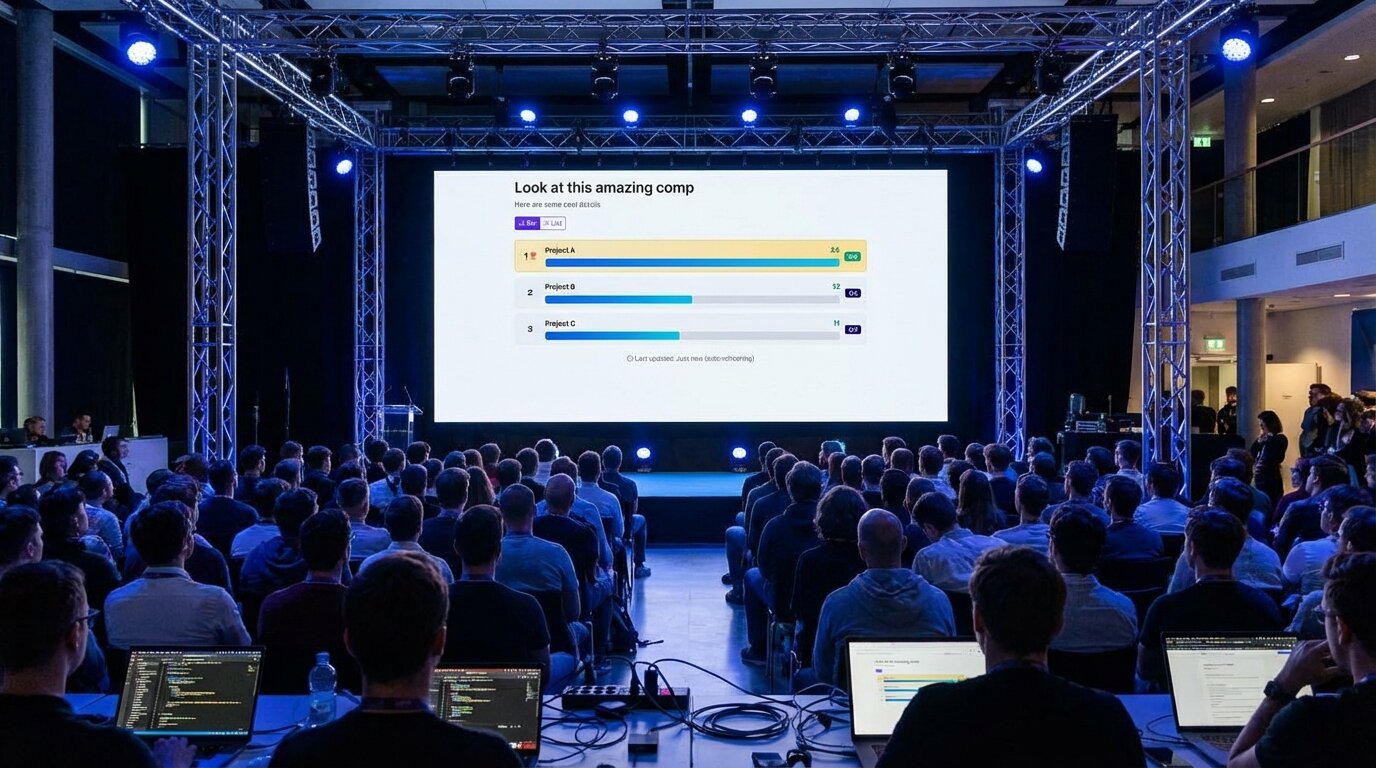
ScoreJudge takes a different shape from the rest: it's not a Judgify-lite. It's a dedicated live competition judging tool. Instead of submissions and multi-round workflows, an organizer adds entries directly, defines scoring criteria, and shares a private link with each judge. Judges score from a phone or tablet — no account, no app install — and a public leaderboard updates in real time, designed to be projected on the big screen during the event itself.
Pricing is public and self-serve: a free plan sized to run a real contest (not a trial preview), then $19/month Plus and $39/month Pro, with one-time and annual options available. Pro covers unlimited competitions — no per-event fee, no onboarding fee, no sales call. Setup is around 5 minutes.
The honest gap versus Judgify: no submission stage, no file uploads, no multi-round private judging. If your event needs contestants to upload PDFs or media before the event, ScoreJudge isn't the right tool. For a hackathon, pitch day, talent show, science fair, bake-off, or live audience-choice award — the events where the judging is the show — that gap is exactly what gets removed from the product.
Best fit: live competition organisers — hackathons, pitch competitions, school talent shows, Eurovision watch parties, community contests — who need a tool a volunteer or PTA can run themselves, with a live leaderboard the audience can see.
5. Submittable
Submittable is the elephant in the wider category. A Y Combinator alumnus based in Missoula, Montana, founded in 2010, $66.6M revenue in 2024. It's positioned more broadly than Judgify — submissions, grants management, social impact programs, and judging — and is the largest player in the wider space.
Pricing isn't publicly listed, but third-party estimates put Starter at around $399/month (up to 5 users), Pro at $799/month (up to 20 users), and Enterprise at $1,499+/month (up to 50 users). Implementation runs $3,000–$10,000+, and the minimum total commitment is typically around $10,000/year. Submittable is enterprise software with enterprise procurement.
Submittable makes sense if you're running grants management or large-scale social impact programs and judging is one workflow within a broader platform need. For organizations evaluating Judgify as one option among many at a higher tier of spend, Submittable is the credible "scale up" choice. For a single live event, it's vastly more product than you need.
Best fit: foundations, nonprofits, and grants administrators running multi-program submission and judging workflows at scale.
6. Spreadsheets + Google Forms (the DIY route)
The honest free option. A Google Form to collect entries, a shared spreadsheet with the rubric, and the organizer averaging columns at the end of the night. For a one-off PTA bake-off or a school art contest with five judges, it works and costs nothing.
The limitations show up as the event scales. No live leaderboard. No private scoring per judge (they see each other's numbers if the sheet is shared, which introduces anchoring bias). No audit trail when a parent disputes a winner. No big-screen reveal moment. The organizer becomes the spreadsheet operator.
For most live events, the DIY route is the first time you run the competition. The second time, you reach for a tool — and the question becomes which one.
Best fit: organizers of a one-off, low-stakes event with under a dozen entries who have no budget at all.
Comparison Table
| Tool | Starting paid price | Free tier | Live leaderboard | Submissions / file uploads | Setup time | Best for |
|---|---|---|---|---|---|---|
| Award Force | $3,125/yr + $2,200 onboarding | No | No (post-round reports) | Yes | Days | Corporate award programs |
| Evalato | €1,900/program | No (free testing) | No (post-round reports) | Yes | Days | EU-based award programs |
| Judging Hub | $9/month | Trial | Yes | Limited | Minutes | Low-stakes monthly billing |
| ScoreJudge | $19/month | Yes (real event) | Yes (real-time) | No | Minutes | Live competition events |
| Submittable | ~$4,800/yr (estimated) | No | No (round-based) | Yes | Weeks | Grants + scaled programs |
| Spreadsheets | $0 | Always | No | Manual | Minutes | One-off, no-budget contests |
| Judgify (reference) | $699/event + onboarding | Yes (100 submissions) | No (round reports) | Yes (5–250 MB) | Days | Multi-round award programs |
Pricing accurate as of May 2026. Confirm current pricing on each vendor's site before committing — this category moves quickly.
Why ScoreJudge Works for Live Events
Most products in this category share a hidden assumption: your event has a submission stage. Contestants send something in, an organizer moderates, judges evaluate over hours or days, and a report goes out at the end. Take that assumption away — the event is live, the contestants are in the room, the judging happens in front of an audience — and the category gets expensive and slow for no reason.
ScoreJudge was built for the live shape. The organizer adds entries directly (no submission stage to configure), criteria are defined in the wizard, judges get private scoring links (no account creation, no app install), and the leaderboard updates the moment a score lands. The whole point is to project that leaderboard during the event so the audience watches rankings move in real time — and announce winners the moment the last team pitches.
The trade-off is honest: no contestant-side submission forms, no file uploads, no multi-round private judging. For a corporate award program or an academic call for papers, that gap is the wrong gap to have. For a hackathon, pitch day, talent show, or community competition, those features were never the point — and removing them is what makes the product cheaper, faster to set up, and easier for one-off judges to use.
See the pitch competition judging page for a deeper walkthrough, the Eurovision voting page for ranked-voting parties, or the audience voting page for "audience choice" awards. For a head-to-head with Judgify specifically, see ScoreJudge vs Judgify.
The Bottom Line
If your event is built around submissions — contestants upload entries, an organizer moderates, judges work through multiple private rounds, and the winner is announced after a final report — Judgify is a deliberate, mature choice, and its closest competitors (Award Force, Evalato, Submittable) are the right comparison set. The category is expensive because the product is genuinely doing more work than a live-scoring tool: storing files, moderating entries, gating rounds, producing audit-grade reports.
If your event is the live moment — the judges are in the room, the audience is watching, the winner gets announced the moment the last team pitches — the submission-lifecycle tools are the wrong shape, and price isn't the only reason. ScoreJudge is the dedicated live-event option in this market, and you can run a real contest on the free plan before you spend a dollar.
Looking for narrower context? See the head-to-head ScoreJudge vs Judgify deep-dive, the Award Force alternatives guide or Submittable alternatives guide if your shortlist also included those tools, or the broader what is judging software? overview.
Frequently Asked Questions
What is the cheapest Judgify alternative?
ScoreJudge is the cheapest paid option that still gives you live judging, real-time leaderboards, and no per-event fees — Plus is $19/month with a free tier that runs a real event. Judging Hub starts even lower at $9/month but is brand new and unproven. Award Force, Evalato, and Submittable all start in the thousands per year. Spreadsheets are free, but you give up the live leaderboard, the per-judge audit trail, and the public reveal moment.
Does Judgify have a free version?
Yes — Judgify's free Basic plan covers 100 submissions, 5 categories, 1 private judging round, and 5 MB file uploads. It's a real plan, not a trial. It's narrow on purpose — larger events outgrow it quickly, which is when the per-event Pro pricing kicks in at $699/event plus an onboarding fee. ScoreJudge's free plan is structured around live events instead of submissions: you can run a full judging panel without paying.
When does Judgify Pro's $699 per-event fee make sense?
When the event has formal submissions, contestants upload files, and you want multiple private judging rounds inside one workflow — a corporate award program, an academic call for papers, or a creative contest with media uploads. The $699 includes onboarding support and Judgify's full submission lifecycle. For a single live evening of judging where contestants pitch in person and the audience watches, $699 is overkill — but for a year-long awards programme, it's reasonable.
Which Judgify alternative is best for hackathons and pitch competitions?
ScoreJudge. Hackathons need live scoring on phones, a leaderboard the audience can see, and a winner announced the moment the last team pitches. Judgify's submission-and-round model is built for a different shape of event. Award Force can also work but is priced like enterprise software ($3,125/year minimum) — for a single hackathon weekend, that's the wrong cost structure.
Can I use a Judgify alternative without an onboarding fee?
Yes. ScoreJudge has no onboarding fee on any plan — you set up the competition yourself in around 5 minutes. Judging Hub is similar (self-serve, monthly billing). Award Force, Evalato, and Submittable all bundle paid implementation/onboarding into the first year, which adds $2,000–$10,000+ to the headline price. If self-serve is a hard requirement, ScoreJudge and Judging Hub are the only credible options.
Does ScoreJudge support submissions and file uploads like Judgify?
No — and that's the cleanest functional gap between the two products. Judgify is built around a submission stage: contestants fill in a form, upload files, and an organizer moderates. ScoreJudge skips that stage entirely. The organizer adds entries directly, which fits live events where contestants arrive in person with a demo, pitch, or performance. For a contest that needs PDF abstracts or video uploads before the event, Judgify is the right category of tool.
Which alternative is closest to Judgify in features and scope?
Award Force and Evalato are the closest matches to Judgify's award-management scope — both cover submissions, moderated entries, multi-round judging, and reporting. Submittable is the largest player but is broadly a grants and social impact platform, not purely judging. If you need Judgify's lifecycle coverage but want a different vendor, those three are the credible options.
How long does it take to switch from Judgify to ScoreJudge?
Minutes. Create a new competition, paste in your entries, add your criteria, and share judge links — no data migration is needed for events that haven't started yet. If you're already mid-round on Judgify, finish that event on Judgify and move the next one to ScoreJudge.
Try ScoreJudge Today
No onboarding call, no per-event fee, no judge accounts. Create a competition in under five minutes — the free plan is enough for a real event.