How Eurovision Voting Works: The Points System, Juries, and Televote Explained
A plain-English guide to Eurovision voting: the 12-10-8-7-6-5-4-3-2-1 points system, the 50/50 jury and televote split, and how to vote from your sofa.
Article Contents
Eurovision is the world's biggest music competition, watched by around 160 million people, and its voting system is one of the most theatrical parts of the show. It's also genuinely confusing the first time you see it. Here's how Eurovision voting actually works, in plain English.
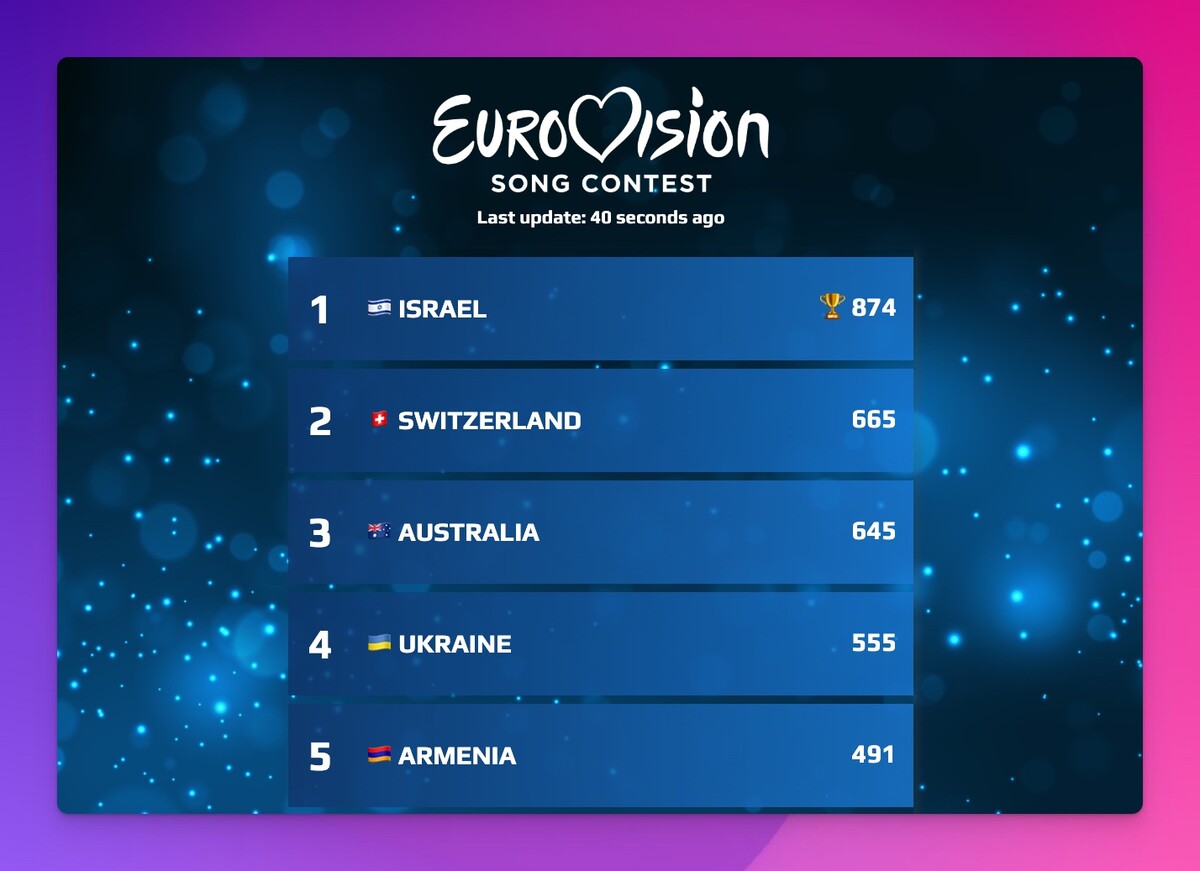
Short version: every participating country gives out two sets of points. One set is decided by a professional jury of five music industry voters in that country. The other is decided by the public watching at home — the televote. Each set awards a 12, a 10, an 8, a 7, a 6, a 5, a 4, a 3, a 2 and a 1 to ten different songs. Add it all together and the song with the most points wins.
The rest of this article unpacks each piece — the points scheme, the jury vs televote split, how people actually vote, why the result sometimes surprises everyone, and how to run an authentic Eurovision-style vote at your own party.
The Eurovision voting system, explained
The Eurovision voting system has two jobs. It needs to be fun to watch — it's a TV show, not a council election — and it needs to feel fair across countries with very different populations, languages and musical tastes.
It solves both problems the same way: every country counts the same. Whether you're Germany with 80 million people or San Marino with 33,000, your country awards the same 58 points (12 + 10 + 8 + 7 + 6 + 5 + 4 + 3 + 2 + 1) on the jury side and another 58 on the televote side. A million extra German votes can't outweigh a tight result in a smaller country.
This is the central trick. Eurovision isn't a popularity contest in the raw "who got the most total votes" sense. It's a ranked competition: every country ranks its ten favourites, and those rankings are converted into points using a fixed scale. That's why it's accurate to call Eurovision a form of ranked voting at the country level.
If you want to run something similar for any group decision — not just music — that's what tools like ScoreJudge's ranked-choice voting are for: the same idea, but for picking a restaurant, an office award, a band-name shortlist, or anything else where you want everyone's ranking to count.
How Eurovision points are calculated
The points scheme has been the same since 1975:
| Ranking | Points awarded |
|---|---|
| 1st favourite | 12 |
| 2nd favourite | 10 |
| 3rd favourite | 8 |
| 4th favourite | 7 |
| 5th favourite | 6 |
| 6th favourite | 5 |
| 7th favourite | 4 |
| 8th favourite | 3 |
| 9th favourite | 2 |
| 10th favourite | 1 |
| 11th and lower | 0 |
A few things to notice:
- The biggest gap is between 1st and 2nd place — 12 vs 10. Being someone's clear favourite is worth a lot more than being their solid second pick. This rewards strong, divisive performances over safe, middle-of-the-road ones.
- The gaps between 2nd and 3rd (10 → 8) and 3rd and 4th (8 → 7) are smaller. Once you're in the top half, the system mostly just preserves your ranking.
- Songs ranked 11th or below from any given country get nothing. There's no participation point. If 25 countries all rank your song 11th, you finish on zero — which is where the dreaded nul points result comes from.
Every country awards two of these full sets — one from its jury, one from its televote. So from a single country, a song can receive between 0 and 24 points (a 12 from each side). And across the contest, a song collects points from every other participating country plus the global Rest of the World televote.
Why the top score is called douze points
Douze points is just French for 12 points. The phrase stuck because Eurovision presenters — the spokespeople reading out each country's jury results — traditionally announce their country's top score last, in both French and English: "et douze points go to…". It's the headline of every country's vote, and it's the score every act in the green room is waiting to hear.
You'll also hear Eurovision scoring and Eurovision rankings used as synonyms for the same system. They all describe the same 12-10-8-7-6-5-4-3-2-1 scheme.
Jury vote vs televote: the 50/50 split
Each country produces two completely independent results.
The jury vote is decided by a panel of five music industry voters from that country — typically a mix of singers, songwriters, producers, music journalists and DJs. They watch a dress rehearsal the night before the live show, score every song from 1 to whatever-the-bottom-is on a fixed rubric (vocal capacity, composition, originality, performance), and their individual rankings are aggregated into a single national ranking. That national ranking is then converted to the 12-10-8-7-6-5-4-3-2-1 scheme above.
The televote is decided by the public watching the live broadcast in that country. Anyone can vote during the voting window — usually a 15-to-40-minute window opened after the last act performs. The total number of votes each song receives is counted, the songs are ranked, and that ranking is again converted into the same point scheme.
The two halves get equal weight: 50% jury, 50% public. This split has been the standard since 2009.
Why use both?
The jury and the public agree on more than people give them credit for, but they disagree often enough to matter. Juries tend to reward technical performance, vocal control, and songwriting that bears repeat listens. The televote rewards what's emotionally landing in the room — staging, charisma, anthems, novelty. Eurovision keeps both because neither half on its own produces a result that feels right to everyone.
You'll see the gap clearly during the broadcast. The presenters reveal the jury points first, country by country. Then the televote totals are added on top in one go, starting from the country in last place and counting up. A song can be sitting 4th after the jury vote and shoot to the top once the televote lands — that's the moment everyone watches Eurovision for.
How to vote in Eurovision
If you're watching from a participating country, you have three options for voting:
- Phone. Call a published premium-rate number assigned to the song you want to vote for. Each country has its own set of numbers, and the price per call is set by the local broadcaster — usually a small amount per call.
- SMS. Text the song's number to a published shortcode. Same idea as phone voting, just slightly cheaper in most countries.
- The official Eurovision app. Search "Eurovision Song Contest" in the App Store or Google Play. App voting has been rolled out to participating countries over recent years and is now the most common way to vote in many of them. You can usually cast up to 20 votes per voting method.
You can vote for as many different songs as you like, up to your country's per-method limit. There's one rule everyone needs to remember: you cannot vote for your own country. The voting lines for your country's act are blocked in your own country, on both the jury and the televote side. This rule has been in place since the first contest in 1956 and is the single most important defence against home-country bias.
The "Rest of the World" televote
If you're watching from a country that doesn't compete — most of the world, including the United States, most of Asia, and much of Africa — there's a single combined global televote known as the Rest of the World vote. It goes through the official Eurovision app or the official Eurovision website. The combined Rest of the World result is treated as a 41st country, awarding its own full set of 12-10-8-7-6-5-4-3-2-1 televote points.
Is there an official Eurovision voting app?
Yes — the official Eurovision Song Contest app, available on iOS and Android. It includes the voting interface in countries where app voting is enabled, the Rest of the World televote, news, song previews, and the running order on contest night.
If what you actually want is to vote at a watch party with friends — everyone ranking the songs from their own phone, no premium-rate SMS — that's a different thing entirely. The official app counts your vote in the real contest result. It doesn't run a private vote among your guests. For that, see the run a Eurovision vote at your own party section below.
A worked example: how one country's 24 points are decided
Imagine your country's jury (the five industry voters) submit their individual rankings of 26 songs. The chairs of the panel aggregate the five rankings into a single national jury ranking from 1st to 26th. The top ten go to the conversion table:
- Jury's #1 song → 12 jury points
- Jury's #2 song → 10 jury points
- Jury's #3 song → 8 jury points
- … and so on down to 1 jury point for the 10th-placed song
Songs ranked 11th to 26th by the jury get zero jury points from this country.
Meanwhile the televote is happening live during the show. Once the voting window closes, every vote is counted. The song with the most public votes gets 12 televote points, the song with the second-most gets 10, and so on down to 1 for the 10th-most-voted song. Songs the public ranked 11th or below get zero televote points from this country.
A single song can therefore collect anywhere between 0 and 24 points from one country: a 12 from the jury, a 12 from the televote, both, or neither.
Do that for every participating country plus the Rest of the World televote, add it all up, and you've got the final scoreboard.
Why the result sometimes surprises you
Two things make Eurovision results feel weird to first-time watchers:
Jury–public divergence. The jury and the televote regularly hand out their 12 points to completely different songs. In some years the gap is huge — a jury winner that the public ranks mid-table, or a televote runaway that the juries had at 15th. This is by design. Critics and audiences don't see the same things, and Eurovision asks for both opinions at full strength.
Bloc voting that isn't really bloc voting. People notice patterns: the Nordic countries hand each other points, the Balkans cluster, Greece and Cyprus exchange 12s with depressing regularity. It looks like coordination. It's almost always something simpler — shared musical taste, shared language, and large diaspora populations who vote enthusiastically for their country's song. Academic work on the voting data, including studies covered by the Electoral Reform Society and Maynooth University, consistently finds that geography, language and migration explain almost all of what looks like bias.
The honest summary: Eurovision voting isn't rigged. It's a panel of dozens of independent juries and tens of millions of independent voters, weighted equally and aggregated by a system that's been refined for fifty years. The system isn't the problem when a result feels off — it's usually that you and a few hundred thousand other people felt very strongly about a song that turned out to be a minority taste.
Run a Eurovision vote at your own party
You don't have to wait for the actual contest to use this voting system. The Eurovision points scheme — 12, 10, 8, 7, 6, 5, 4, 3, 2, 1 — is a great way to run any vote at a watch party, a music quiz, or even a non-music decision among friends.
The pen-and-paper version is fine: print scorecards, hand them out, read totals at the end. The faster version is to use a tool that does the maths for you. With ScoreJudge's Eurovision Voting, every guest drags the acts into their preferred order on their phone, the 12-10-8-7-6-5-4-3-2-1 points are awarded automatically, and a live leaderboard updates on the TV between songs. No app downloads for your guests, no spreadsheet to maintain.
The same engine works for any ranked vote — pick a restaurant, pick a band name, pick the company off-site location. That's what ScoreJudge's ranked-choice voting is for, framed for non-Eurovision groups: the Eurovision points scheme is just ranked voting with a 1956 tuxedo on.
If you're throwing a full watch party, how to host the ultimate Eurovision party covers the rest — food, decorations, drinking games, the lot.
Eurovision voting — FAQ
"How does Eurovision voting work?"
Each participating country gives out two sets of points: one chosen by a professional jury of music industry voters, and one chosen by the public watching at home. Each set awards 12, 10, 8, 7, 6, 5, 4, 3, 2 and 1 points to its ten favourite songs. Add up both sets across every country and the song with the most points wins.
"What does 'douze points' mean?"
Douze points is French for 12 points — the maximum a single country can award in either the jury or the televote. It's the most famous phrase in Eurovision because it's the score that decides the night. The presenter from each country traditionally announces their jury's 12 points last, in French and English, which is why people remember the phrase.
"Why does Eurovision use the 12, 10, 8, 7, 6, 5, 4, 3, 2, 1 points system?"
The current scheme has been used since 1975. It rewards a country's ten favourite songs with a sharp gap between first and second place — 12 vs 10 — so being someone's clear favourite is worth more than being a safe middle pick. The jumps get smaller further down the list, which makes the top of the ranking the decisive part.
"Can you vote for your own country?"
No. Both the jury and the televote in each country are blocked from voting for their own act. This is the single biggest rule against home-country bias and it's been in place since the contest began.
"How can I vote in Eurovision?"
If you're watching from a participating country, you can usually vote by phone, by SMS, or through the official Eurovision app during the voting window. Each country runs its own voting line and sets its own price per vote. Viewers outside the participating countries can vote through a single global 'Rest of the World' televote that goes through the app or the contest website.
"Is there an official Eurovision voting app?"
Yes. The official Eurovision app (search 'Eurovision Song Contest' in the App Store or Google Play) lets you vote during the live shows in countries where app voting is allowed, plus the global Rest of the World vote. For watch parties, where you want your own group to vote on the acts, a tool like ScoreJudge's Eurovision scorecard is what you want — the official app only counts your vote in the real result.
"When did Eurovision switch to a 50/50 jury and televote split?"
The current 50/50 split — half jury, half public — was reintroduced in 2009 and has been the standard ever since. Before that the format flipped between 100% televote, 100% jury, and various mixes depending on the year.
"Why do the same countries always vote for each other?"
What's called 'bloc voting' is real but smaller than it looks. Neighbouring countries share diaspora populations and musical tastes, so a Greek song genuinely scores well with Cypriot voters even without any conspiracy. Academic studies of voting patterns (the Electoral Reform Society has covered this) find that geography, language, and migration explain most of what people call bias.
"How are Eurovision rankings calculated at the end?"
Every country's jury points are revealed first, country by country, in a sequence designed for maximum suspense. The televote totals for each song are then added on top in one go, starting from the country in last place after the jury vote and finishing with the leader. The song with the highest combined total wins.

Written by Caspar von Wrede
Founder of Score Judge. Building tools for real-time competition judging at live events.