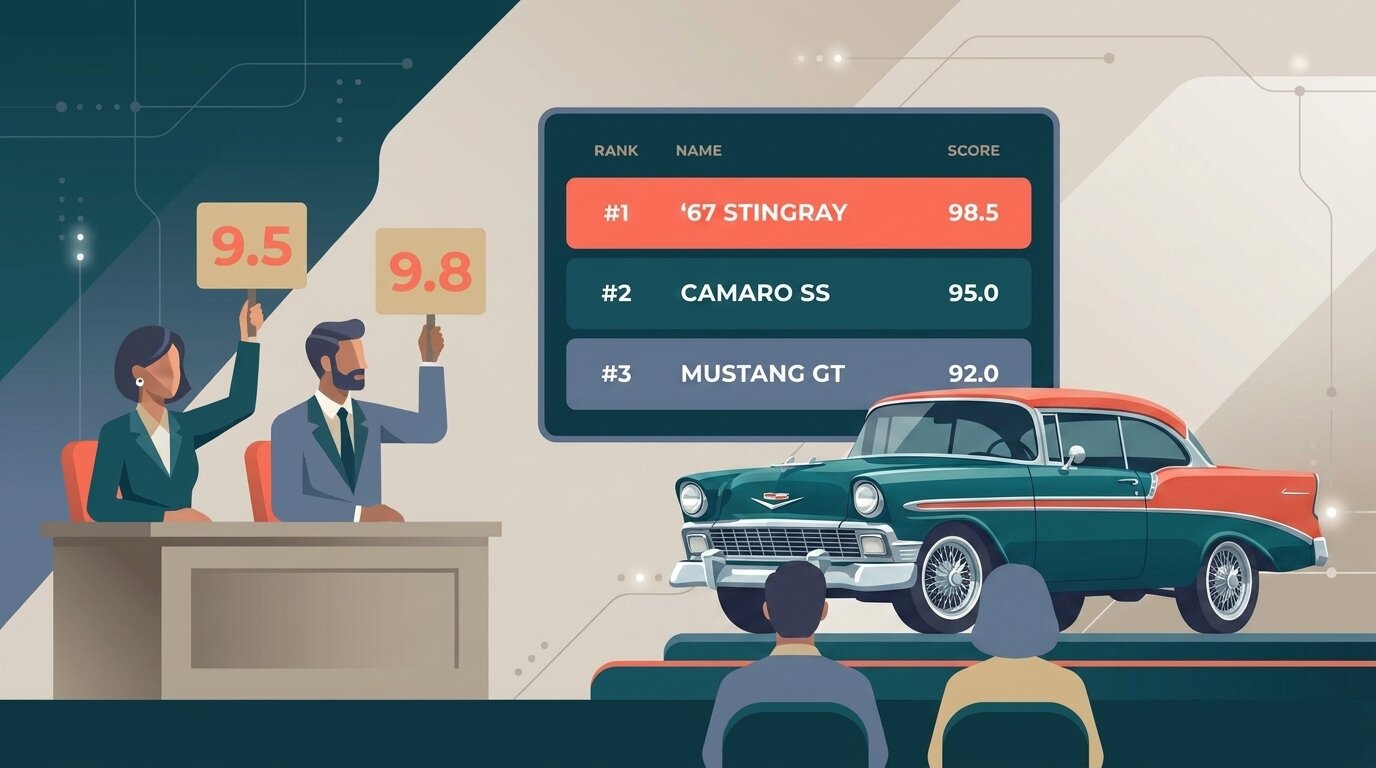
What is a car show judging form?
A car show judging form is the scoresheet a judge uses to rate each vehicle on shared criteria — paint and body, engine bay, interior, wheels, undercarriage, and overall presentation. A digital judging form replaces the paper clipboard: judges score on their phone, the totals calculate automatically, and the class results are ready the moment the last car is scored.
Most car shows still run on paper. Judges walk the field with a clipboard, tick boxes on a printed sheet, and someone tallies the numbers by hand at the registration tent while entrants stand around waiting for trophies. It works, but it's slow, mistakes creep into the arithmetic, and nobody can see the standings until they're announced.
A digital judging form fixes all three problems. Judges score on a phone, the math happens in the background, and a live leaderboard updates as each car is scored. For background on the broader category, see what is judging software.
Car show judging criteria & printable sheet
There's no single national standard — clubs and organizers set their own categories — but most car show judging sheets score on the same core areas. A car show judging sheet typically scores six categories for 100 points per car: paint and body, interior, engine compartment and craftsmanship at 20 points each, presentation and overall impression at 10 each. Print it for your judges, or open it in ScoreJudge and let the phones do the adding up.
Car show judging sheet
 Provided by ScoreJudge.com
Six categories, 100 points per car, taken from the sheet of a real show. The four big categories count 20 points each, presentation and overall impression 10 each.
| Category | What judges look for | Points | Score |
|---|---|---|---|
| Paint & body | Finish quality, shine, panel gaps, chrome and trim, no chips or swirl marks | 0–20 | |
| Interior | Upholstery, dash, carpet, headliner, trim condition and detail | 0–20 | |
| Engine compartment | Cleanliness, detailing, wiring, correct for the build (stock or custom) | 0–20 | |
| Craftsmanship | Quality of the work up close: restoration, fabrication, fit and finish | 0–20 | |
| Presentation | Display, stance, wheels and tires, how the car is shown | 0–10 | |
| Overall impression | The whole car: wow factor, cohesion, first impression | 0–10 | |
| Total | / 100 | ||
What the results look like in ScoreJudge
The same sheet, scored on phones by 3 judges, with the entries split into categories. Nobody adds anything up: each category's ranking and every criterion's points are there the moment the last score is in.
Car Show
All judges have submitted their scores
Classic cars 4
Trucks 2
Hide score breakdown
Classic cars
| Entry | Paint & body | Interior | Engine compartment | Craftsmanship | Presentation | Overall impression | Total |
|---|---|---|---|---|---|---|---|
| 1969 Camaro SS · Dale R. | 57 | 55 | 56 | 58 | 28 | 29 | 283 |
| 1957 Bel Air · Rosa M. | 55 | 57 | 52 | 55 | 27 | 28 | 274 |
| 1972 Datsun 240Z · Ken T. | 52 | 48 | 54 | 53 | 26 | 26 | 259 |
| 1965 Mustang Fastback · Gary P. | 54 | 46 | 47 | 49 | 27 | 25 | 248 |
Trucks
| Entry | Paint & body | Interior | Engine compartment | Craftsmanship | Presentation | Overall impression | Total |
|---|---|---|---|---|---|---|---|
| 1979 Ford F-150 · Ray B. | 50 | 45 | 51 | 50 | 25 | 26 | 247 |
| 1986 Toyota Pickup · Luis A. | 44 | 42 | 49 | 47 | 24 | 23 | 229 |
Example with made-up entries. Every score is 3 judges' points added up.
In ScoreJudge you set these categories up once as scoring criteria, give each its own maximum points, and every judge sees the same form. Adjust the mix per class — add originality for stock and survivor classes, or creativity for custom, rat-rod, and modified classes. Stock daily drivers and full concours builds shouldn't be measured on the same sheet, and per-criterion points let the math reflect that.
How it works
Setting up digital scoring for a car show takes about as long as it used to take to print and sort the paper forms.
- Create the show and add the entries Add the vehicles (or entry numbers, or classes) and decide how many judges will score them. Run separate competitions per class, or score everything on one leaderboard — your call.
- Build your judging form Add criteria like paint, engine, interior, wheels, and presentation, and give each its own maximum points. This is your digital scoresheet, and every judge scores against the same one.
- Send judges their links Each judge gets a private link. They open it on a phone as they walk the field — no app install, no login. They see one car at a time with a score input for each category.
- Score live during the show Judges score, hit submit, and move to the next car. The leaderboard updates instantly. Optional: drop the highest and lowest score per car to cancel out an outlier judge.
- Display the live leaderboard Put the public leaderboard URL on a TV or laptop at the registration tent. Entrants can also open it on their own phones and watch the classes shape up.
Key features to look for
Not every judging tool fits a car show. The features that matter most on the field:
Multi-criteria scoring
Judges score paint, engine, interior, and presentation as separate inputs per car — not a single number that hides how the score was built.
Per-criterion points
Paint and engine usually carry more weight than wheels. Each category should carry its own maximum so the totals match your judging rules.
Drop high/low scores
Cancel out one judge who scores a favorite too generously by dropping the highest and lowest score per car automatically.
Phone-friendly judging
Judges walk the field, so scoring has to work one-thumbed on a phone in the sun — big touch targets, no fiddly desktop UI.
Live public leaderboard
A URL that updates in real time on a tent TV or entrants' phones, so nobody stands around wondering who's winning.
People's choice voting
Run a parallel audience vote so spectators pick a People's Choice award alongside the judged winners.
Who uses car show judging software?
Digital scoring earns its keep across every kind of car event:
Car clubs & local meets
Monthly cruise-ins and club shows where a couple of volunteers judge a few dozen cars. The free plan covers most club events end-to-end, and there's no back-tent tally holding up the trophies.
Charity & community shows
Fundraiser shows run by volunteers who don't have time to reconcile paper sheets. Judges score on their phones, and a People's Choice ballot lets every attendee take part.
Regional & multi-class shows
Bigger events with dozens of classes (stock, custom, muscle, import, truck, motorcycle) and multiple judging teams. Per-class competitions keep the scoring clean without paper jams or lost sheets.
Concours & specialty events
Detailed judging with heavy weighting on originality and undercarriage. Per-criterion points and a stored per-judge breakdown handle the scrutiny these events attract.
Dealership & brand shows
Marque-specific and dealer-hosted shows that want a polished, branded leaderboard on the big screen and a fast, professional result.
Digital scoring vs. paper judging sheets
Most car shows still hand judges a clipboard and a stack of printed forms. The two approaches compared:
| Capability | Digital scoring | Paper judging sheets |
|---|---|---|
| Tally time | ✓ Instant | 30–90 minutes at the tent after judging closes |
| Live standings for entrants | ✓ On a screen or their phones | ✗ Not possible |
| Math errors | ✓ None — software totals it | Common — hand-tally mistakes under time pressure |
| Lost or wind-blown sheets | ✓ Impossible | Happens on every windy field |
| Drop high/low | ✓ Automatic | Manual recalculation per car |
| People's choice vote | ✓ Built in, from any phone | A jar of paper slips to count by hand |
| Per-judge breakdown for disputes | ✓ Stored, exportable | Filed in a folder somewhere |
| Cost per event | Free plan covers small shows | Printing + clipboards + tent scorers |
Paper still works. It just costs the entrants the live result, costs the organizer the tent tally, and costs the judges the time they spend re-checking arithmetic in the sun.
Why choose ScoreJudge for car shows
ScoreJudge is competition judging software built for live events — including car shows. Set up your judging form, score every vehicle on paint, engine, and presentation in real time, and let entrants follow the leaderboard from their phones. Free plan covers small club shows; paid plans add more judges, classes, and custom branding.
What ScoreJudge is used for
Car show organizers use ScoreJudge across the full range of formats:
- Club meets and cruise-ins. Quick to set up, free plan covers most club shows, no app install for judges.
- Multi-class regional shows. Separate classes for stock, custom, muscle, import, and truck, each with its own criteria and points.
- Charity and community fundraisers. Judged awards plus a People's Choice ballot so every attendee takes part.
- Concours and specialty judging. Heavy weighting on originality and undercarriage with a full per-judge audit trail.
- Spectator "people's choice" awards. Pair the judges' panel with audience voting for a crowd-picked winner.
Who uses ScoreJudge for car shows
- Car club officers and event chairs running monthly meets and annual shows.
- Charity and community organizers putting on fundraiser shows with volunteer judges.
- Show promoters managing multi-class regional events with several judging teams.
- Concours judges and marque specialists who'd rather score on a phone than fill in paper.
- Dealerships and brands hosting marque-specific shows that want a polished live result.
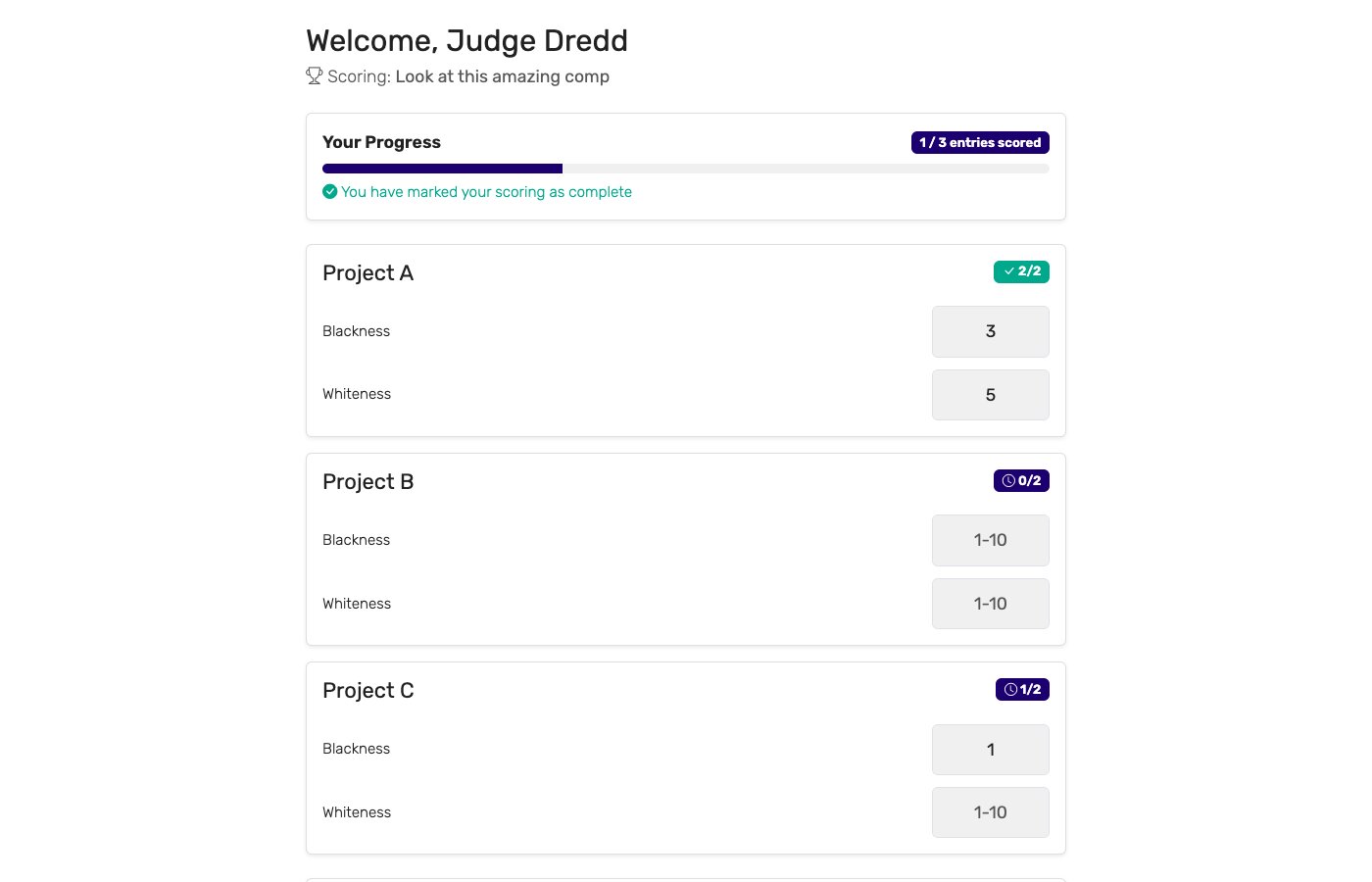
Free accounts cover small club shows end-to-end. Paid plans add more judges, more entries, and custom branding for larger events.
How to choose the right car show scoring tool
If you're evaluating tools for a car show, weigh these against your event:
- How many cars and judges? Free tiers vary. Make sure the plan covers your entry count and the size of your judging panel.
- Does judging work on a phone? Judges are on their feet in the sun, not sitting at a table. The interface has to be touch-first and readable outdoors.
- Can categories count for different amounts? If paint counts more than wheels, each category must carry its own maximum. A single flat scale won't match your judging rules.
- Is the leaderboard truly live? For a tent-screen display you want updates without anyone refreshing anything.
- Can spectators vote? A built-in people's choice vote saves you a jar of paper slips and gets every attendee involved.
- What does it cost per event? Some platforms charge per event. For a club cruise-in that's a non-starter — a real free plan or a subscription matters.
For a deeper look at running fair competitions, see how to judge a competition fairly and running competitions with multiple judges. To add a crowd-picked award, see audience voting.
Score your next car show with ScoreJudge
Set up your judging form, classes, and live leaderboard in about ten minutes. Free plan covers club shows end-to-end — no per-event fees, no judge logins, no paper.
Frequently asked questions
What is a car show judging form?
A car show judging form is the scoresheet a judge uses to rate each vehicle on a set of criteria — typically exterior and paint, engine bay, interior, wheels and tires, undercarriage, and overall presentation. Each category is scored out of a maximum, and the totals decide the class winners. A digital form replaces the paper clipboard: judges score on their phone, the math is automatic, and the results are instant.
Is there a free printable car show judging sheet?
Yes. This page has a free printable car show judging sheet with six categories and 100 points per car: paint and body, interior, engine compartment and craftsmanship at 0–20 each, presentation and overall impression at 0–10 each. It prints on one page with lines for the entry number, judge and notes. The same sheet can also be opened in ScoreJudge, so judges score on their phones and the class totals add up automatically.
What criteria are used to judge a car show?
Most car shows score on six core categories: exterior and paint, engine bay, interior, wheels and tires, undercarriage, and overall presentation or "wow factor". Each category is usually scored 0–10 or 0–25, and each can carry its own maximum so a full concours build isn't judged the same as a daily driver. Add class-specific categories — originality for stock classes, creativity for custom and rat-rod classes — as needed.
Is there a free car show scoring app?
Yes. ScoreJudge has a free plan that covers small local and club shows end-to-end. Judges score from their phones with no app install and no accounts, the leaderboard updates live, and there are no per-event fees. Larger shows with more classes, judges, and vehicles can upgrade to a paid plan.
How do you run people's choice voting at a car show?
Alongside the judges' panel, open an audience-voting ballot so every spectator can vote for their favorite car from their phone. ScoreJudge tallies the crowd vote in parallel with the judged results, so you can hand out both a Best in Show (judged) and a People's Choice (audience) award at the same event.
Can I display live car show results on a screen?
Yes. ScoreJudge provides a public leaderboard URL you can put on a TV, projector, or laptop by the registration tent. As judges submit scores, the standings update instantly, and entrants can open the same link on their phones to follow along — no login required.
How do you keep car show judging fair?
Use clearly-defined categories so every judge scores the same things, brief the panel before doors open, score on a wide enough range (0–10, not 1–3) to separate similar builds, and consider dropping the highest and lowest judge score per car to cancel out an outlier. ScoreJudge supports all of these and keeps the per-judge breakdown so any contested placement can be reviewed. For a deeper look, see how to judge a competition fairly.