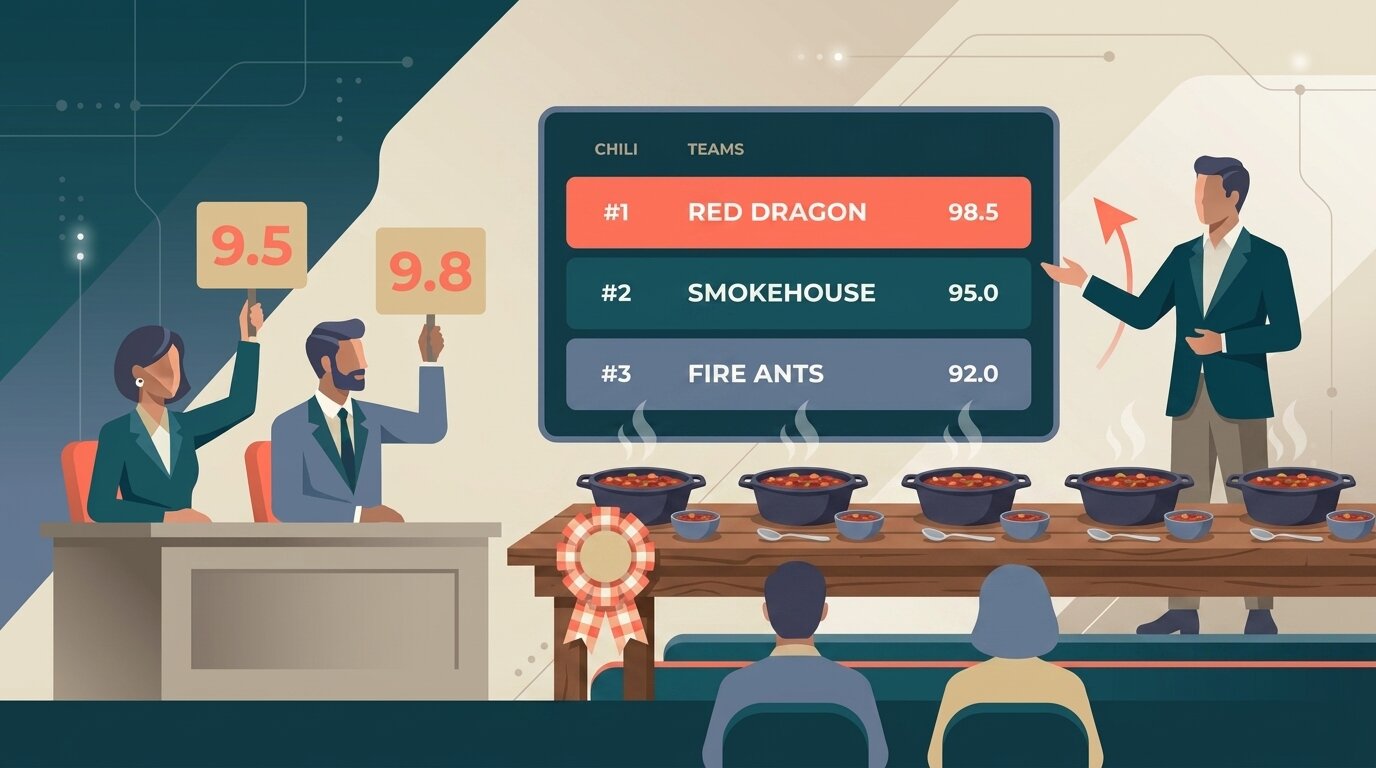
What is a chili cook-off scorecard?
A chili cook-off scorecard is the sheet a judge uses to rate each chili on shared criteria — aroma, color, consistency, taste and flavor, and aftertaste. A digital scorecard replaces the paper printable: judges score numbered cups on their phone, the totals calculate automatically, and the winners are ready the instant the last cup is tasted.
Most cook-offs still run on paper. You print a stack of judging sheets off Etsy or Pinterest, hand each judge a clipboard, and someone tallies the numbers by hand at the serving table while teams stand around waiting to hear who won. It works, but it's slow, the arithmetic goes wrong under pressure, and nobody sees the standings until they're announced.
A digital scorecard fixes all three. Judges score on a phone, the math happens in the background, and a live leaderboard updates as each cup is scored. For background on the broader category, see what is judging software, or browse the full judging software hub.
Chili cook-off judging criteria & printable score sheet
There's no single national standard, but the classic chili-judging criteria — the ones used in ICS and CASI-style contests — are well established. Entries are judged blind: each chili is served in a numbered cup with no team name attached, so nobody scores a friend's pot higher than a stranger's. A typical food judging score sheet for chili scores five categories from 0 to 10, 50 points per cup: aroma, color, consistency, taste and aftertaste. Print it for your judges, or open it in ScoreJudge and let the phones do the adding up.
Chili cook-off judging sheet
 Provided by ScoreJudge.com
Five categories, each scored 0–10, 50 points per cup. Judges write only the cup number on the sheet, never the cook's name, so the judging stays blind.
| Category | What judges look for | Points | Score |
|---|---|---|---|
| Aroma | Appetizing and inviting, not sour, burnt or flat | 0–10 | |
| Color | A rich, natural red-brown, not greasy, pale or muddy | 0–10 | |
| Consistency | Meat and liquid in balance, not watery, greasy or paste-like | 0–10 | |
| Taste / flavor | Overall flavor and balance of spices, the category that matters most | 0–10 | |
| Aftertaste (heat / finish) | Pleasant lingering warmth and a clean finish, not harsh or bitter | 0–10 | |
| Total | / 50 | ||
What the results look like in ScoreJudge
The same sheet, scored on phones by 3 judges, with the entries split into categories. Nobody adds anything up: each category's ranking and every criterion's points are there the moment the last score is in.
Chili Cook-Off
All judges have submitted their scores
Red 3
Green 3
Hide score breakdown
Red
| Entry | Aroma | Color | Consistency | Taste / flavor | Aftertaste (heat / finish) | Total |
|---|---|---|---|---|---|---|
| Cup 7 · Brisket & ancho | 27 | 26 | 27 | 29 | 28 | 137 |
| Cup 14 · Texas red | 26 | 28 | 25 | 27 | 26 | 132 |
| Cup 9 · Cincinnati-style | 25 | 21 | 22 | 23 | 24 | 115 |
Green
| Entry | Aroma | Color | Consistency | Taste / flavor | Aftertaste (heat / finish) | Total |
|---|---|---|---|---|---|---|
| Cup 3 · Green chile pork | 28 | 22 | 26 | 26 | 27 | 129 |
| Cup 5 · Hatch green & beef | 25 | 24 | 26 | 27 | 25 | 127 |
| Cup 11 · Chile verde chicken | 24 | 25 | 23 | 24 | 22 | 118 |
Example with made-up entries. Every score is 3 judges' points added up.
In ScoreJudge you set these categories up once as scoring criteria, give each its own maximum points, and every judge sees the same form. Adjust the mix for your contest — many organizers weight taste more heavily than the others, or add a Red vs. Green or homestyle vs. traditional class with its own sheet. Because entries are keyed to numbered cups, the judging stays blind end to end.
How it works
Setting up digital scoring for a cook-off takes about as long as it used to take to print and collate the paper sheets.
- Create the cook-off and add the entries Add each entry as a numbered cup (Cup 1, Cup 2, Cup 3…) rather than a team name, so judging stays blind. Keep the master cup-to-team list at the registration table for the reveal.
- Build your judging sheet Add criteria like aroma, color, consistency, taste, and aftertaste, and give each its own maximum points. This is your digital scorecard, and every judge scores against the same one.
- Send judges their links Each judge gets a private link. They open it on a phone at the tasting table — no app install, no login. They see one numbered cup at a time with a score input for each category.
- Score blind during the tasting Judges taste, score, hit submit, and move to the next cup — water and crackers in between to reset the palate. The leaderboard updates instantly. Optional: drop the highest and lowest score per entry to cancel out an outlier judge.
- Reveal the winners live Put the public leaderboard URL on a TV or laptop at the serving table. When judging closes, match the winning cup numbers back to the teams and hand out the trophies.
Key features to look for
Not every judging tool fits a chili cook-off. The features that matter most at the tasting table:
Blind numbered entries
Entries scored as numbered cups, not team names, so judges rate the chili on its merits and nobody can play favorites.
Multi-criteria scoring
Judges score aroma, color, consistency, taste, and aftertaste as separate inputs per cup — not one number that hides how it was built.
Per-criterion points
Taste usually counts for more than color. Each category should carry its own maximum so the totals match your contest rules.
Drop high/low scores
Cancel out one judge who scored a cup unusually high or low by dropping the highest and lowest score per entry automatically.
Phone-friendly judging
Judges are standing at a tasting table with a spoon in one hand — scoring has to work one-thumbed on a phone with big touch targets.
People's Choice voting
Run a parallel audience vote so attendees pick a People's Choice award alongside the judged winners.
Who uses chili cook-off judging software?
Digital scoring earns its keep across every kind of cook-off:
Chili societies & sanctioned contests
Clubs running ICS or CASI-style contests with formal aroma-color-consistency-taste-aftertaste scoring and blind numbered cups. Per-criterion points and a stored per-judge breakdown handle the scrutiny sanctioned events attract.
Charity & community fundraisers
Fundraiser cook-offs run by volunteers who don't have time to reconcile paper sheets. Judges score on their phones, and a People's Choice ballot lets every ticket-holder take part and drives donations.
BBQ & food festivals
Bigger events with dozens of teams and several judging tables. Numbered-cup entries keep the tasting blind and the scoring clean without lost or salsa-stained sheets.
Workplace & office cook-offs
Team-building chili contests where the whole office tastes and votes. The free plan covers most office cook-offs end-to-end, and everyone scores from their own phone.
Restaurants, breweries & taprooms
Venue-hosted cook-offs that want a polished, branded leaderboard on the big screen and a fast, professional result to announce to the room.
Digital scoring vs. paper judging sheets
Most cook-offs still hand judges a clipboard and a stack of printed scorecards. The two approaches compared:
| Capability | Digital scoring | Paper judging sheets |
|---|---|---|
| Tally time | ✓ Instant | 20–60 minutes at the table after tasting closes |
| Live standings for teams | ✓ On a screen or their phones | ✗ Not possible |
| Math errors | ✓ None — software totals it | Common — hand-tally mistakes under time pressure |
| Lost or stained sheets | ✓ Impossible | Happens on every messy tasting table |
| Blind judging | ✓ Numbered cups by default | Only if you carefully hide the team names |
| Drop high/low | ✓ Automatic | Manual recalculation per entry |
| People's Choice vote | ✓ Built in, from any phone | A jar of paper slips to count by hand |
| Cost per event | Free plan covers small cook-offs | Printing + clipboards + table scorers |
Paper still works. It just costs the teams the live result, costs the organizer the table tally, and costs the judges the time they spend re-checking arithmetic between samples.
Why choose ScoreJudge for chili cook-offs
ScoreJudge is competition judging software built for live events — including chili cook-offs. Set up your scorecard, score every numbered cup on aroma, taste, and aftertaste in real time, and let teams follow the leaderboard from their phones. Free plan covers small cook-offs; paid plans add more judges, entries, and custom branding.
What ScoreJudge is used for
Cook-off organizers use ScoreJudge across the full range of formats:
- Sanctioned society contests. Formal aroma-color-consistency-taste-aftertaste scoring with blind numbered cups and a full per-judge audit trail.
- Multi-class festivals. Separate classes for red, green, homestyle, and salsa, each with its own criteria and points.
- Charity and community fundraisers. Judged awards plus a People's Choice ballot so every attendee takes part.
- Workplace cook-offs. Quick to set up, free plan covers most office contests, no app install for anyone.
- Crowd "people's choice" awards. Pair the judges' panel with audience voting for a crowd-picked winner.
Who uses ScoreJudge for cook-offs
- Chili society officers and event chairs running sanctioned and club contests.
- Charity and community organizers putting on fundraiser cook-offs with volunteer judges.
- Festival promoters managing multi-team events with several judging tables.
- HR and office social committees running team-building chili contests.
- Restaurants, breweries, and taprooms hosting cook-offs that want a polished live result.
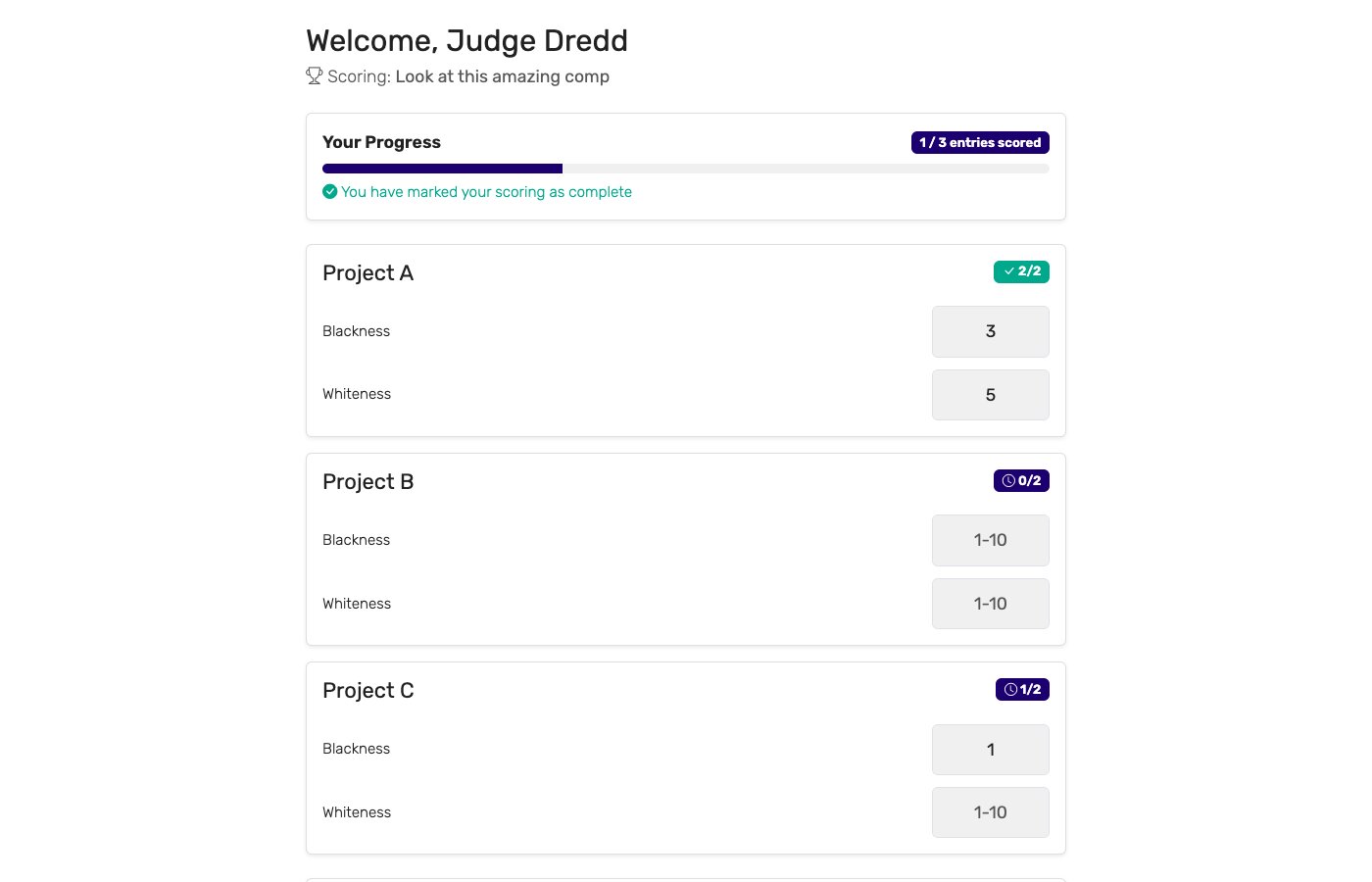
Free accounts cover small cook-offs end-to-end. Paid plans add more judges, more entries, and custom branding for larger contests.
How to choose the right chili cook-off scoring tool
If you're evaluating tools for a cook-off, weigh these against your event:
- How many entries and judges? Free tiers vary. Make sure the plan covers your entry count and the size of your judging panel.
- Does it support blind numbered entries? Judging by numbered cup instead of team name is the single biggest fairness feature at a cook-off.
- Does judging work on a phone? Judges are standing at a tasting table, not sitting at a desk. The interface has to be touch-first and quick.
- Can categories count for different amounts? If taste counts more than color, each category must carry its own maximum. A single flat scale won't match your rules.
- Can spectators vote? A built-in People's Choice vote saves you a jar of paper slips and gets every attendee involved.
- What does it cost per event? Some platforms charge per event. For an annual charity cook-off that's a non-starter — a real free plan or a subscription matters.
For a deeper look at running fair contests, see how to judge a competition fairly and running competitions with multiple judges. To add a crowd-picked award, see audience voting.
Score your next chili cook-off with ScoreJudge
Set up your scorecard, numbered cups, and live leaderboard in about ten minutes. Free plan covers small cook-offs end-to-end — no per-event fees, no judge logins, no paper.
Frequently asked questions
What is a chili cook-off scorecard?
A chili cook-off scorecard is the sheet a judge uses to rate each chili on a set of criteria — traditionally aroma, color, consistency, taste and flavor, and aftertaste or heat finish. Each category is scored on a fixed scale (commonly 0–10), and the totals decide the winners. A digital scorecard replaces the paper sheet: judges score numbered cups on their phone, the math is automatic, and results are instant.
Is there a free printable chili cook-off judging sheet?
Yes. This page has a free printable chili cook-off judging sheet with the five classic categories scored 0–10 each, 50 points per cup: aroma, color, consistency, taste and flavor, and aftertaste. It prints on one page with lines for the cup number, judge and notes, and no line for the cook's name, so the judging stays blind. The same sheet can also be opened in ScoreJudge, so judges score on their phones and the totals add up automatically.
What are the criteria for judging a chili cook-off?
The classic chili-judging criteria, used in ICS and CASI-style contests, are aroma, color, consistency, taste and flavor, and aftertaste (the heat and finish). Each is usually scored 0–10, and taste carries the most weight. Aroma is how it smells, color is appetizing appearance, consistency is the texture and thickness of the chili and its liquid, taste is the overall flavor balance, and aftertaste is the heat build and clean finish.
How do you judge a chili cook-off fairly?
Judge blind: serve each entry in a numbered cup with no team name attached, so nobody scores a friend's chili higher. Give every judge the same criteria and the same 0–10 scale, provide water and plain crackers to reset the palate between samples, and have judges score independently before comparing. Dropping the highest and lowest judge score per entry cancels out an outlier. ScoreJudge supports blind numbered entries and keeps the per-judge breakdown for any contested placement. For a deeper look, see how to judge a competition fairly.
Is there a free chili cook-off scoring app?
Yes. ScoreJudge has a free plan that covers small cook-offs end-to-end. Judges score numbered cups from their phones with no app install and no accounts, the leaderboard updates live, and there are no per-event fees. Larger contests with more judges and entries can upgrade to a paid plan.
How do you run a People's Choice award at a chili cook-off?
Alongside the judges' panel, open an audience-voting ballot so every attendee can vote for their favorite chili from their phone. ScoreJudge tallies the crowd vote in parallel with the judged results, so you can hand out both a judged Grand Champion and a People's Choice award at the same event — which is perfect for charity and community cook-offs.
Can I show live chili cook-off results on a screen?
Yes. ScoreJudge provides a public leaderboard URL you can put on a TV, projector, or laptop at the serving table. As judges submit scores for each numbered cup, the standings update instantly, and teams can open the same link on their phones to follow along — no login required.