What is gymnastics scoring software?
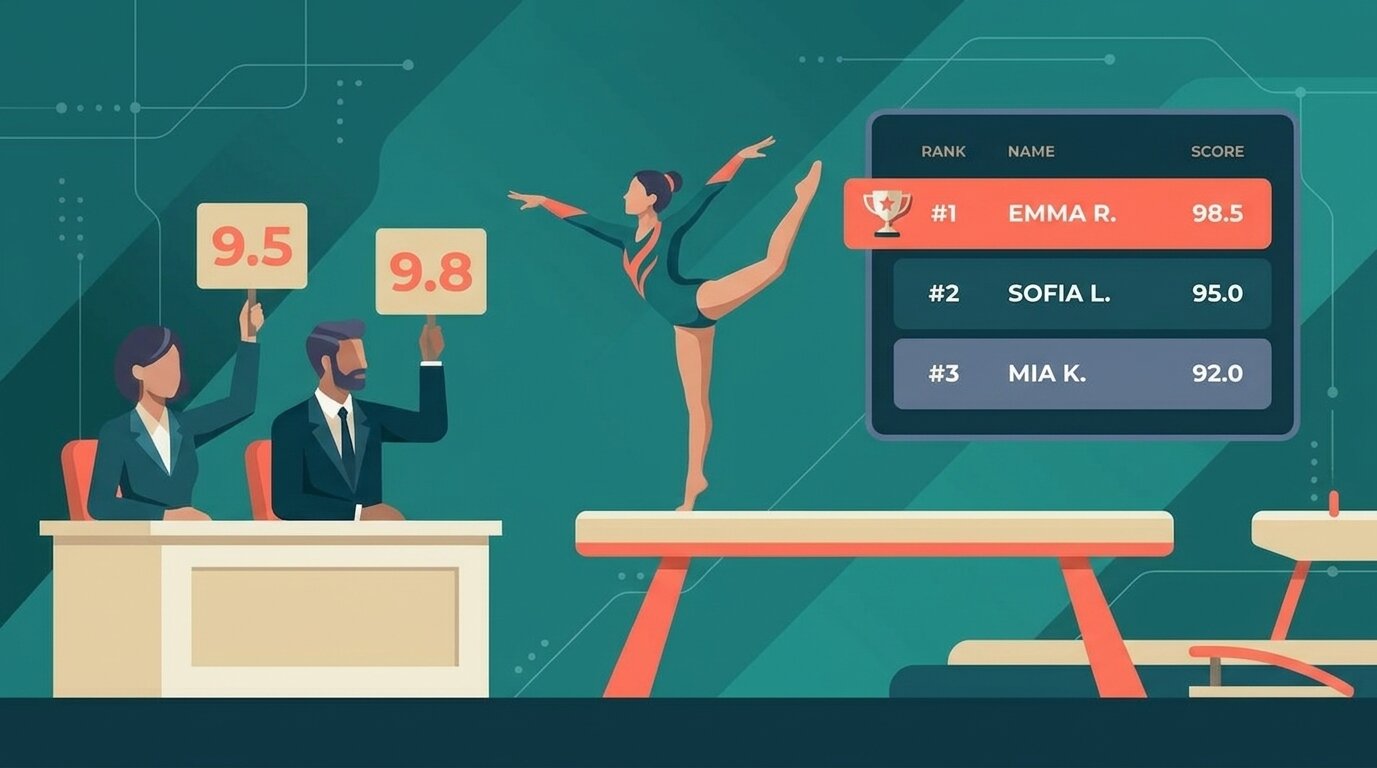
Gymnastics scoring software lets judges enter routine scores on a phone or tablet instead of paper flash cards. Judges record a difficulty (D) score, an execution (E) score out of 10, and any deductions per routine — the software combines them into a final score, ranks the gymnasts, and updates a live leaderboard the moment a score is submitted.
Most club meets still run on paper. Judges scribble deductions on a scoresheet, someone flips a flash card, and a table crew hand-tallies the all-around while gymnasts and parents wait for results. It works, but it's slow, the arithmetic goes wrong under time pressure, and nobody can see the standings until they're posted on the wall.
Software fixes all three. Judges score on a phone, the D-score, E-score, and deductions combine automatically, and a live leaderboard updates by apparatus, level, and all-around as the meet runs. For background on the broader category, see what is judging software.
How gymnastics scoring works: the D-score and E-score
Modern gymnastics uses an open-ended scoring model with two separate parts, and understanding it is the whole point of setting up your scoresheet correctly.
Difficulty (D-score)
The D-score rewards what the gymnast attempts — the value of the skills, the connections between them, and the composition requirements for that apparatus. It has no fixed ceiling: a harder routine can earn a higher difficulty value. In recreational and lower levels, many meets skip an open-ended D-score and simply use a fixed start value (often 10.0).
Execution (E-score)
The E-score is how well the routine is performed. It starts at 10.0, and judges subtract deductions for bent knees, flexed feet, wobbles, steps or hops on landing, and falls. A clean routine loses very little; a shaky one loses a lot.
Final score
The final score is the D-score plus the E-score after deductions. In a fixed-start-value format it's simply the start value minus total deductions. Either way, ScoreJudge does the math so your table crew doesn't.
Gymnastics judging criteria & sample scoresheet
There's no single scoresheet every meet uses — governing bodies, levels, and apparatus all differ — but a per-routine breakdown for a club or invitational meet looks like this:
| Gymnast | Difficulty (D) | Execution (E, out of 10) | Deductions | Final |
|---|---|---|---|---|
| Vault — A. Rivera | 5.0 | 10.0 | −0.9 (step on landing, form) | 14.10 |
| Bars — A. Rivera | 4.2 | 10.0 | −1.4 (leg separation, short handstand) | 12.80 |
| Beam — A. Rivera | 4.6 | 10.0 | −1.8 (wobble, fall −1.0) | 12.80 |
| Floor — A. Rivera | 4.8 | 10.0 | −1.1 (out of bounds, form) | 13.70 |
| All-around total | 53.40 | |||
In ScoreJudge you set these fields up once as scoring criteria — a difficulty input, an execution input, and a deductions input per routine — and every judge sees the same form. Adjust the mix per apparatus and level: a fixed 10.0 start value for recreational levels, an open-ended D-score for optionals, and different deduction rules for vault, bars, beam, and floor. Cheer and tumbling meets swap in their own criteria the same way.
How it works
Setting up digital scoring for a meet takes about as long as it used to take to print and sort the paper scoresheets.
- Create the meet and add the gymnasts Add the gymnasts (or team and bib numbers), group them by level and session, and decide how many judges will score each apparatus.
- Build your scoresheet Add criteria for difficulty, execution, and deductions — or a single start-value input for recreational levels. This is your digital scoresheet, and every judge scores against the same one.
- Send judges their links Each judge gets a private link. They open it on a phone or tablet at their apparatus — no app install, no login. They see one routine at a time with an input for each part of the score.
- Score live during the meet Judges enter the score, hit submit, and move to the next gymnast. The leaderboard updates instantly. With more than one execution judge, average their scores and optionally drop the highest and lowest.
- Display the live leaderboard Put the public leaderboard URL on a gym TV or laptop. Families can also open it on their phones and watch the all-around and per-apparatus standings shape up.
Key features to look for
Not every judging tool fits a gymnastics meet. The features that matter most in the gym:
D-score + E-score + deductions
Judges enter difficulty, execution, and deductions as separate inputs — not one number that hides how the routine was scored.
Custom criteria per apparatus
Vault, bars, beam, and floor have different rules. Each apparatus and level should carry its own scoresheet and deduction logic.
Multiple judges per apparatus
Average several execution judges and drop the highest and lowest to cancel out an outlier on a busy apparatus.
Phone and tablet judging
Judges score at the apparatus, not at a desk. Scoring has to work one-thumbed on a phone or tablet with big, readable inputs.
Live all-around leaderboard
A URL that updates in real time by apparatus, level, and all-around, so nobody waits by the wall for posted results.
Crowd favorite voting
Run a parallel audience vote so the gym picks a crowd favorite alongside the judged all-around winners.
Who uses gymnastics scoring software?
Digital scoring earns its keep across every kind of meet that isn't tied to a certified sanctioned system:
Gymnastics clubs & in-house meets
Monthly in-house and intra-club meets where coaches and volunteers judge a session of gymnasts. The free plan covers most club events end-to-end, and there's no table crew holding up the awards.
Invitational meet organizers
Multi-club invitationals with several levels and sessions running at once. Per-apparatus scoring and separate levels keep the results clean without paper jams or lost scoresheets.
School & college teams
Team meets and dual meets where a couple of judges score each event. Judges score on their phones, and the all-around and team totals calculate as the meet runs.
Cheer & tumbling
Cheer, tumbling, and acro competitions that judge on their own criteria — difficulty, execution, and deductions map cleanly onto a custom scoresheet per division.
Recreational leagues
Fun meets and recreational league days using a simple fixed start value and execution deductions. Easy to set up, easy for volunteer judges, live results for the families.
Digital scoring vs. paper scoresheets
Most club meets still hand judges a clipboard, a stack of printed scoresheets, and a set of flash cards. The two approaches compared:
| Capability | Digital scoring | Paper scoresheets |
|---|---|---|
| All-around tally time | ✓ Instant | Table crew hand-tallies after each session |
| Live standings for families | ✓ On a screen or their phones | ✗ Posted on the wall later |
| Math errors | ✓ None — software totals it | Common — hand-tally mistakes on the all-around |
| Lost or mixed-up scoresheets | ✓ Impossible | Happens on a busy apparatus rotation |
| Average judges / drop high-low | ✓ Automatic | Manual recalculation per routine |
| Crowd favorite vote | ✓ Built in, from any phone | A jar of paper slips to count by hand |
| Per-judge breakdown for inquiries | ✓ Stored, exportable | Filed in a folder somewhere |
| Cost per meet | Free plan covers small meets | Printing + flash cards + table crew |
Paper still works. It just costs the families the live result, costs the organizer the table-crew tally, and costs the judges the time they spend re-checking arithmetic between rotations.
Why choose ScoreJudge for gymnastics
ScoreJudge is competition judging software built for live events — including gymnastics meets. Set up your scoresheet, score every routine on difficulty, execution, and deductions in real time, and let families follow the all-around from their phones. Free plan covers small club and in-house meets; paid plans add more judges, apparatus, and custom branding.
One honest caveat: ScoreJudge is not a certified FIG or USA Gymnastics scoring system, and it doesn't try to be. Sanctioned elite and JO/DP competitions require certified judges and official software tied to the governing body's rules. ScoreJudge fits club meets, invitationals, school and college teams, cheer and tumbling, and recreational or in-house competitions — where you set your own criteria per apparatus and level.
What ScoreJudge is used for
Meet organizers use ScoreJudge across the full range of non-sanctioned formats:
- In-house and intra-club meets. Quick to set up, free plan covers most club meets, no app install for judges.
- Multi-level invitationals. Separate levels and sessions, each with its own scoresheet, running on the same live leaderboard.
- School and college team meets. Per-apparatus judging with automatic all-around and team totals.
- Cheer, tumbling, and acro. Custom difficulty-and-execution criteria per division with a full per-judge audit trail.
- Crowd favorite awards. Pair the judging panel with audience voting for a gym-picked winner.
Who uses ScoreJudge for gymnastics
- Club owners and head coaches running in-house and intra-club meets.
- Invitational meet directors managing multiple clubs, levels, and sessions.
- School and college coaches scoring team and dual meets.
- Cheer and tumbling organizers judging on their own division criteria.
- Recreational program leads putting on fun meets with volunteer judges.
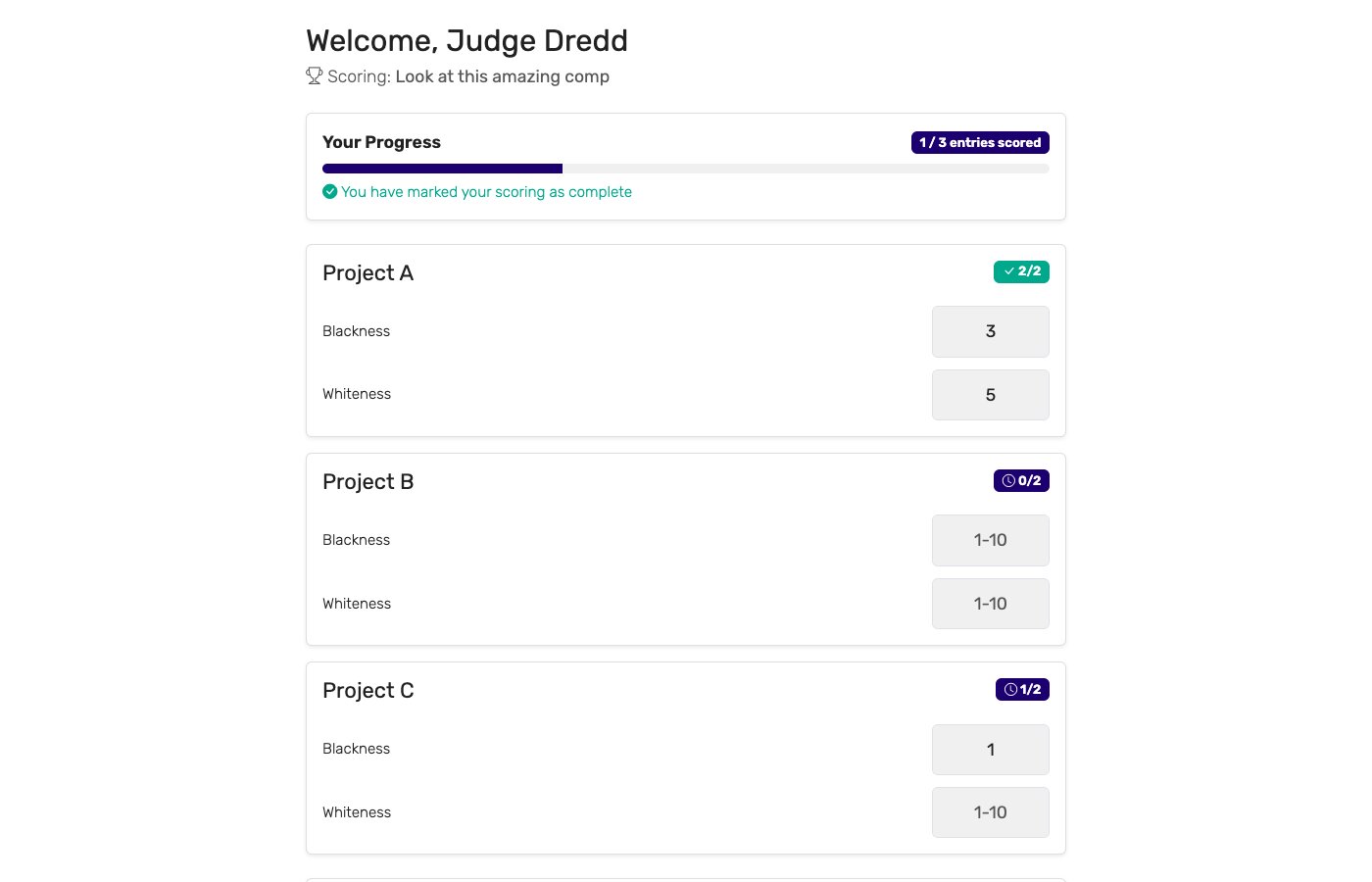
Free accounts cover small club and in-house meets end-to-end. Paid plans add more judges, more gymnasts, and custom branding for larger invitationals.
How to choose the right gymnastics scoring tool
If you're evaluating tools for a meet, weigh these against your event:
- Sanctioned or not? If you're running a certified elite or JO/DP meet, you need the governing body's official system. For club, school, cheer, and recreational meets, a flexible tool like ScoreJudge fits.
- Can you model D-score, E-score, and deductions? The tool has to let judges enter difficulty, execution out of 10, and deductions separately — not just a single number.
- Custom criteria per apparatus and level? Vault, bars, beam, and floor differ, and recreational levels use a fixed start value. Your scoresheet has to adapt.
- Does judging work on a phone or tablet? Judges score at the apparatus, not at a desk. The interface has to be touch-first and readable in a busy gym.
- Is the leaderboard truly live? For a gym-screen display you want the all-around to update without anyone refreshing anything.
- What does it cost per meet? Some platforms charge per event. For a monthly in-house meet that's a non-starter — a real free plan or a subscription matters.
For a deeper look at running fair competitions, see how to judge a competition fairly, browse the broader judging software category, and to add a crowd-picked award see audience voting.
Score your next gymnastics meet with ScoreJudge
Set up your scoresheet, levels, and live leaderboard in about ten minutes. Free plan covers club and in-house meets end-to-end — no per-event fees, no judge logins, no paper.
Frequently asked questions
What is gymnastics scoring software?
Gymnastics scoring software lets judges enter routine scores on a phone or tablet instead of paper flash cards and scoresheets. Judges record a difficulty (D) score, an execution (E) score out of 10, and any deductions per routine; the software combines them into a final score, ranks the gymnasts, and updates a live leaderboard. ScoreJudge is built for clubs, invitationals, and school meets — you set your own criteria per apparatus and level.
How does gymnastics scoring work?
Modern gymnastics uses an open-ended system with two parts. The D-score (difficulty) rewards the value of the skills a gymnast performs and has no fixed ceiling. The E-score (execution) starts at 10.0, and judges subtract deductions for form breaks, wobbles, steps on landing, and falls. The final score is the D-score plus the E-score after deductions. In lower recreational levels, meets often use a start value (for example 10.0) and only subtract execution deductions.
Is there a free gymnastics scoring app?
Yes. ScoreJudge has a free plan that covers small club meets and in-house competitions end-to-end. Judges score from their phones with no app install and no accounts, the leaderboard updates live, and there are no per-event fees. Larger invitationals with more judges, apparatus, and gymnasts can upgrade to a paid plan.
Can ScoreJudge replace an elite FIG or USAG scoring system?
No — and we won't pretend otherwise. Sanctioned elite and JO/DP competitions require certified judges and official scoring systems tied to the governing body's rules. ScoreJudge is built for club meets, invitationals, school and college teams, cheer and tumbling, and recreational or in-house competitions where you set your own criteria. It handles the D-score, E-score, and deduction model faithfully, but it isn't a certified replacement for FIG or USA Gymnastics systems at the sanctioned level.
Can I display live gymnastics results on a screen?
Yes. ScoreJudge provides a public leaderboard URL you can put on a TV, projector, or laptop in the gym. As judges submit scores, the standings update instantly by apparatus, level, and all-around, and families can open the same link on their phones to follow along — no login required.
How do you keep gymnastics judging fair with multiple judges?
Brief the judging panel on the criteria before the meet, use a wide enough deduction scale so similar routines separate cleanly, and put more than one judge on each apparatus. With multiple execution judges you can average their scores and drop the highest and lowest to cancel out an outlier. ScoreJudge supports all of these and stores the per-judge breakdown, so any contested placement can be reviewed on the spot. For a deeper look, see how to judge a competition fairly.