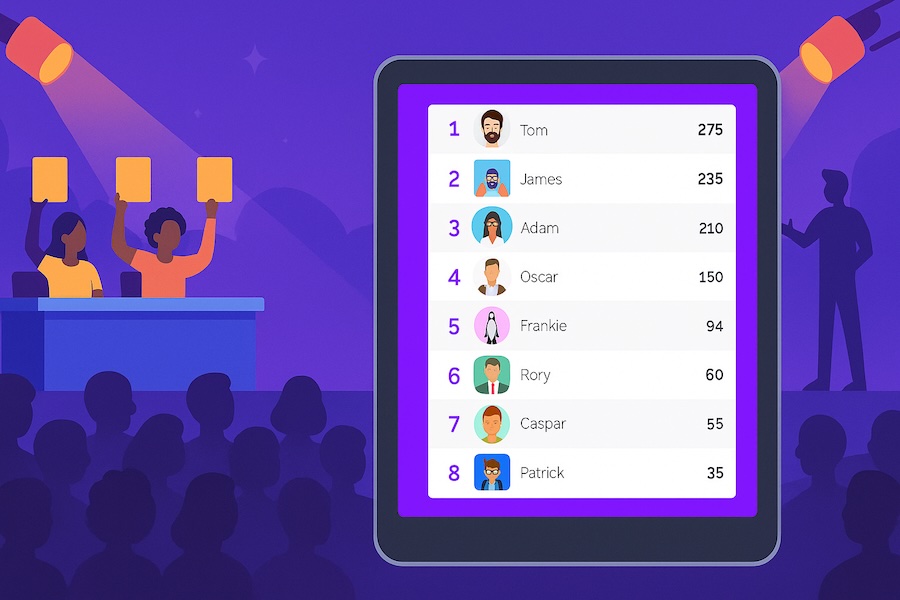
Panel Judging vs Audience Voting: Which Is Right for Your Event?
A practical comparison of panel judging and audience voting: who each is for, how the results differ, and a simple way to pick between them — or run both.
Article Contents
The difference between panel judging and audience voting isn't a feature comparison. It's a decision about what your event is for.
A panel of expert judges produces a credible result. An audience vote produces a popular result. Sometimes those land in the same place. Often they don't — and which one you want depends on whether the legitimacy of the winner matters more than the engagement of the room.
This post lays out the actual difference, when each fits, and a third option people don't think about: running both at the same event.

The Two Models in One Sentence Each
Panel Judging — a closed group of named judges, each scoring privately on shared criteria, with results aggregated across the panel. Used for science fairs, hackathon finals, pitch competitions, and any event where the credibility of the result matters.
Audience Voting — anyone with the link can score or rank the entries, anonymously, from their phone. Used for talent shows, awards nights, cook-offs, watch parties, and any event where audience engagement is part of the show.
Both can produce a leaderboard. Both can scale from five entries to fifty. The choice between them comes down to one question: when the winner is announced, does anyone in the room need to trust that the judging was rigorous?
Where Panel Judging Is the Right Call
The argument for panel judging is straightforward: not all audience members are qualified to evaluate the thing being judged.
- A wine competition judged by general audience members and the same competition judged by sommeliers produce different (and probably differently-correct) results.
- A surgical technique demonstration evaluated by other surgeons is meaningful in a way that audience voting is not.
- A code quality assessment in a hackathon final — three engineers reading the codebase will produce a different ranking than 200 demo-day attendees voting on which presentation looked the most exciting.
Panel judging is also the right answer when the stakes are real:
- Cash prizes that aren't trivial
- Career consequences (job offers, scholarships, accelerator entry)
- Public credibility on the line (industry awards, certification, ranking)
In those cases, anonymous audience voting opens a door to vote-stuffing or group bias that makes the result feel cheap, even when the winner is genuinely the best. A small panel of named judges with a clear rubric is what people expect, and what they trust.
Panel judging also gives you something audience voting can't: per-judge accountability. You know who scored what, you can flag outliers, and you can investigate after the fact if there's a dispute. Audience voting is anonymous by design.
For the mechanics of running a panel well, see how to score a competition with multiple judges and how to judge a competition fairly.
Where Audience Voting Is the Right Call
The argument for audience voting is also straightforward: at some events, the audience is the point.
- A school talent show where parents and students want to weigh in on the winner.
- A company innovation day where engagement matters more than expert validation.
- A watch party voting on "best costume", "favourite dish", "song of the night".
- A cook-off where the tasters are the audience, by definition.
In all of these, asking three judges to decide while 200 people watch silently kills the energy. The audience wants a stake. Audience voting gives them one, and the leaderboard updating live as people vote becomes part of the show.
Audience voting also wins on friction. Panel judging requires recruiting judges, briefing them, sending them links, and chasing them when scores aren't in. Audience voting needs a QR code on a slide. For a casual event, the setup cost difference is the difference between actually running it and not.
The trade-off is the one mentioned above: anyone can vote, and anyone might vote in bad faith or without the expertise the entries deserve. For most casual events, this doesn't matter. For high-stakes events, it does.
What the Results Actually Look Like
A side-by-side example. Imagine a pitch competition with five startups. Same five entries, two scoring models.
Panel Judging (5 judges, scoring on Market, Team, Product, Presentation, weighted 30/25/25/20):
The panel's scores cluster around an expert view of which company has the best business case. The team with the strongest pitch deck might still lose to the team with the weakest pitch but strongest underlying business — because the rubric explicitly weights "market opportunity" heavily and "presentation" lightly.
Audience Voting (200 voters, scoring on a single "overall" criterion):
The audience vote tracks how much they enjoyed the pitch. The team with the best presentation skills usually wins, even if their business is shakier. There's no rubric forcing voters to separate "did I enjoy this" from "would I invest in this".
Both results are valid. They're answering different questions. The panel answers "which company should win the prize"; the audience answers "which pitch did the audience like most". If you only run one, pick the one whose question matches what the prize is for.
This is exactly why some events run both.
The Third Option: Run Both in Parallel
Many of the better-run events at every scale do this — film festivals, hackathons, talent shows, internal company innovation events:
- Judges' Choice — awarded by the panel, the credibility prize
- People's Choice — awarded by audience vote, the engagement prize
This works because the two prizes signal different things. The panel prize is about expertise; the audience prize is about resonance. Both winners get a moment on stage. Sometimes it's the same entry, which is a strong signal that everyone agrees. More often it's different entries, which itself becomes a talking point ("our judges loved X, but the audience picked Y — both deserved the recognition").
In Score Judge, the standard pattern is to create two competitions for the same event — one in Panel Judging mode, one in Audience Scoring or Audience Ranking mode — and award separate prizes from each. Same entries, same event, two parallel leaderboards. The voters and the judges don't see each other's scores.
It costs about ten extra minutes of setup over running just one. The payoff is an event that feels both serious and inclusive.
A Decision Cheat-Sheet
If you're still not sure, this is the rough version:
| Question | If yes → |
|---|---|
| Is there meaningful prize money or career impact? | Panel Judging |
| Does the audience know the domain better than they know the entries? | Panel Judging |
| Is audience engagement part of the show? | Audience Voting |
| Are you optimising for setup time over rigour? | Audience Voting |
| Is the event hybrid / partly online? | Either works — Audience Voting scales easier |
| Do you want both a credibility prize and an engagement prize? | Run both |
The most common mistake isn't picking the wrong one — it's picking neither and ending up with a single celebrity judge making a unilateral call from the stage. Both panel judging and audience voting are improvements over that.
Mechanics: What Each Looks Like in Score Judge
For reference, here's how the two modes differ inside Score Judge:
Panel Judging — Each judge gets a unique private link. No login, no app. They open the link on their phone, tablet, or laptop, score every entry on the criteria you've defined, and submit. Scores are saved automatically. As the organizer, you see a live progress tracker (which judge has scored what) and the aggregated leaderboard.
Audience Voting — One shared voting link goes to everyone in the audience, usually as a QR code on the main screen. Voters open the link, score or rank every entry, then submit the whole ballot once. Per-device duplicate prevention stops casual double-voting. The leaderboard aggregates all submissions in real time.
The two modes share the same dashboard, same entries, same criteria editor. Only the voting interface and the link-sharing model differ. You pick the mode once at competition creation; it can't be switched afterwards (so if you're unsure, run both).
For setup details, see the step-by-step audience voting guide for the audience side and multi-judge scoring for the panel side.
Frequently Asked Questions
Can the audience and the panel score the same competition?
Not in the same competition entity — Score Judge locks the mode (panel or audience) when the competition is created. The standard pattern is to create two competitions for the same event, one for each mode, with the same entries. Voters and judges then see separate leaderboards and award separate prizes.
Does audience voting produce less fair results than panel judging?
It depends on what "fair" means. Audience voting is less rigorous because there's no rubric or accountability. But for a popularity contest — class favourite, audience-choice award — the audience's opinion is the correct measure of fairness. The two modes are answering different questions.
Which one is more work to run?
Audience voting is less work day-of: no judges to recruit, brief, or chase. Panel judging is more work upfront but more controlled in execution. If you're new to running judged events, audience voting is the lower-stakes way to start.
What if I expect 500+ voters?
Audience voting scales fine — Score Judge's data model is designed for it. The constraint is your plan's voter cap (25 free, 250 on Plus, unlimited on Pro). For events that big, upgrade before the event.
Can I use audience voting for a serious award?
You can, but the result will reflect popularity rather than rigour. If credibility matters, run a panel — or run both and let the panel award the headline prize while the audience awards a parallel one.
If you've decided which mode fits your event, the deep-dive guides are here:
- For audience voting — How to Set Up Audience Voting at Live Events
- For panel judging — How to Score a Competition with Multiple Judges
- For background on fair judging in general — How to Judge a Competition Fairly

Written by Caspar von Wrede
Founder of Score Judge. Building tools for real-time competition judging at live events.