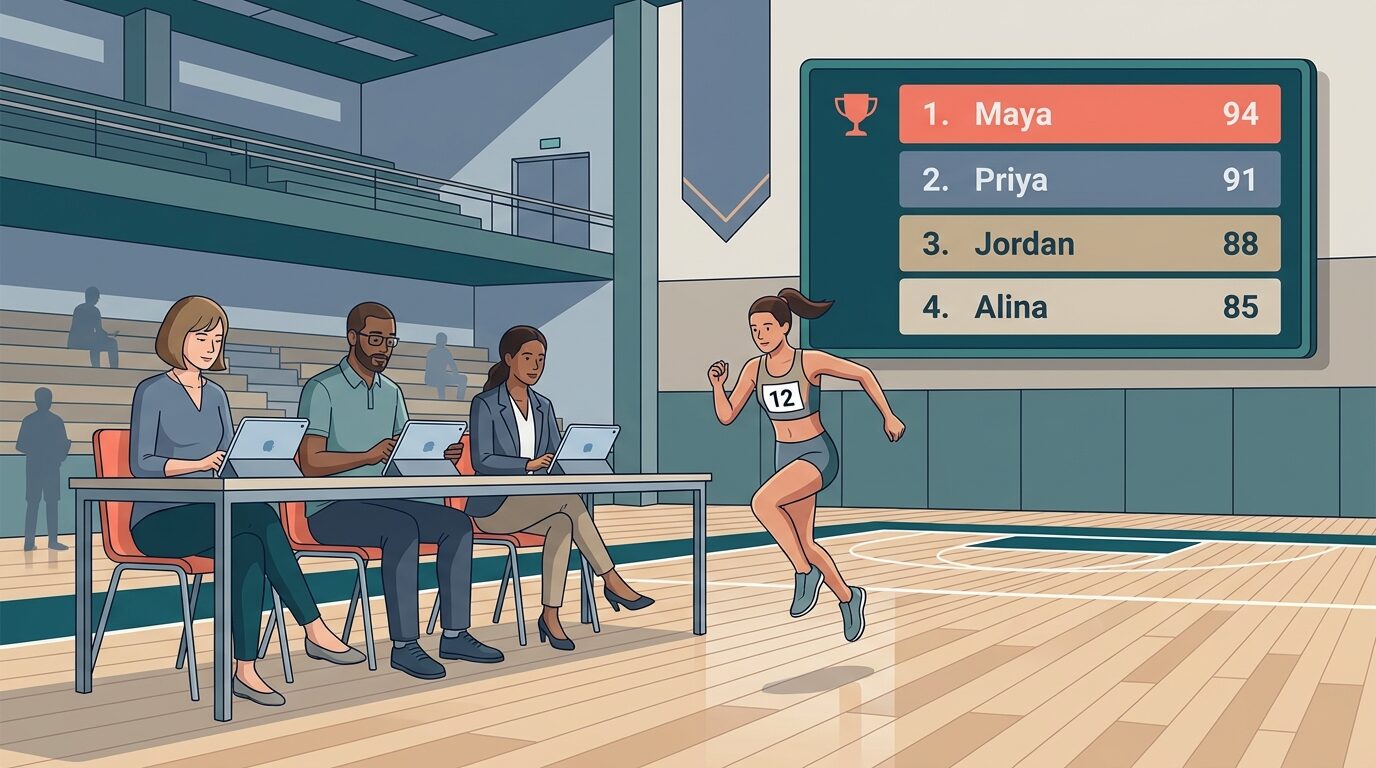
The score sheets
Each sheet below is one page per candidate, per judge. The criteria and point scales are the ones tryout panels actually use — we pulled the patterns from the dance, cheer and colorguard tryouts run on ScoreJudge rather than inventing a grid. Hit Print the score sheets and you'll get the four sheets on four pages, with the blurb and the sales pitch stripped out.
Cheer tryout score sheet
Eight categories, scored 0–5, 40 points per judge. This is the shape a high school or middle school cheer tryout wants: enough categories that a strong tumbler and a strong performer are separated properly, few enough that a judge can score 50 candidates in an afternoon without the sheet turning into paperwork.
| Category | What judges look for | Points | Score |
|---|---|---|---|
| Motions | Sharpness, placement, locked arms, clean hits, no rebound | 0–5 | |
| Jumps | Height, toe touch form, flexibility, controlled landing | 0–5 | |
| Tumbling | Standing and running passes, technique, sticks the landing | 0–5 | |
| Cheer / chant | Voice projection, words clear, confidence, no rushing | 0–5 | |
| Dance | Choreography retention, rhythm, full-out energy | 0–5 | |
| Showmanship & spirit | Facials, eye contact, energy that carries to the back of the gym | 0–5 | |
| Poise & appearance | Posture, grooming, uniform, how they recover from a mistake | 0–5 | |
| Coachability & attitude | Takes correction, supports the others in the group | 0–5 | |
| Total | / 40 | ||
Notes. Coachability is worth keeping even though it feels soft — it is the category that most often explains why the third-best tumbler made the squad. If your tryout has no tumbling round at all, drop the row and score out of 35 rather than redistributing the points; a clean denominator is easier to explain to a parent than a weighting you invented on the day.
Dance team tryout score sheet
Ten categories, scored 0–10, 100 points per judge. This one is close to verbatim: the same ten-row rubric turns up again and again on the dance team and studio auditions run on ScoreJudge, which makes it about as close to a standard as this sport has.
| Category | What judges look for | Points | Score |
|---|---|---|---|
| Flexibility | Extension, lines, range through leaps and kicks | 0–10 | |
| Turn technique | Spotting, passé placement, clean finish, doubles and triples | 0–10 | |
| Jump / leap technique | Height, split, pointed feet, quiet landing | 0–10 | |
| Choreography | Dances the combination as taught, no simplifying the hard parts | 0–10 | |
| Musicality & timing | On the count, phrasing, hits the accents with the music | 0–10 | |
| Retention & application | How much of the combination stuck, and whether corrections were applied | 0–10 | |
| Execution & cleanliness | Finished movement, controlled transitions, no sloppy edges | 0–10 | |
| Performance quality | Facials, projection, commitment to the style | 0–10 | |
| Work ethic & attitude | Effort through the learning block, focus, how they treat the room | 0–10 | |
| Overall impression | Would this dancer make the team better next season? | 0–10 | |
| Total | / 100 | ||
Notes. Ten categories is the ceiling before judges start scoring on autopilot. If you're auditioning more than about 60 dancers, cut it to six and move retention, work ethic and overall impression into a second, shorter callback sheet — which is exactly what the biggest audition we've seen on ScoreJudge does: 859 candidates scored by six judges on five rows apiece.
Colorguard & majorette audition score sheet
Ten categories, scored 0–10, 100 points per judge. Equipment work is what makes this sheet different from the dance one: tosses and drop spins get their own rows, and so does the ability to keep going after a drop — which in guard is a genuine skill, not a consolation prize.
| Category | What judges look for | Points | Score |
|---|---|---|---|
| Tosses | Height, rotation count, clean catch, consistent release | 0–10 | |
| Drop spins | Even timing, wrist control, flag stays flat and readable | 0–10 | |
| Extensions | Full arm length, straight lines, matched height across both sides | 0–10 | |
| Recovery | Picks up after a drop and rejoins the phrase without stopping | 0–10 | |
| Dance & body work | Movement quality between equipment work, posture, travel | 0–10 | |
| Memory | How much of the taught phrase came back without prompting | 0–10 | |
| Timing | With the count and with the rest of the group, not just with themselves | 0–10 | |
| Energy | Sustains it to the end of the phrase, not just the first eight counts | 0–10 | |
| Facial expressions | Projects to the back of the stands, stays in character after a mistake | 0–10 | |
| Appearance & overall impression | Presentation, discipline, and how they'd read on the field in uniform | 0–10 | |
| Total | / 100 | ||
Notes. For majorette and twirling, swap tosses and drop spins for your own equipment rows — baton rolls, two-baton work, aerials — and leave the rest alone. The performance half of the sheet transfers unchanged.
Sports tryout rubric (basketball, volleyball, soccer)
Six categories, scored 0–5, 30 points per coach. Sports tryouts split differently from performance tryouts: you are scoring skills that a drill can isolate, plus two things no drill shows you. The sport-specific rows here are basketball; swap them for passing, setting and hitting for volleyball, or first touch, passing and finishing for soccer.
| Category | What coaches look for | Points | Score |
|---|---|---|---|
| Shooting | Form, range, consistency once they're tired | 0–5 | |
| Ball handling | Both hands, under pressure, keeps their head up | 0–5 | |
| Defense | Stance, footwork, effort off the ball when nobody's watching | 0–5 | |
| Game sense | Spacing, passing reads, is in the right place before the ball is | 0–5 | |
| Athleticism | Speed, first step, motor across the whole session | 0–5 | |
| Coachability | Takes a correction and applies it in the next rep; talks to teammates | 0–5 | |
| Total | / 30 | ||
Notes. Keep athleticism and coachability out of the sport-specific rows. Bundle them in and a fast kid with no jump shot scores the same as a shooter who won't defend, and you lose the two pieces of information that actually decide a roster.
What tryout panels actually run
Printable sheets on the internet tend to be somebody's idea of what a tryout should look like. These numbers come from the cheer, dance and colorguard tryouts and auditions being scored on ScoreJudge right now — anonymised, and rounded where a number would otherwise point at one squad.
- Five judges is the median panel. More than eight in ten tryouts run three judges or more. Panels of six and seven are common for dance team; the biggest we see is eleven.
- Around sixteen candidates is the median field — but the range is enormous. Plenty of studio auditions have eight dancers; the largest single tryout on the platform scored 859.
- Five criteria is the median sheet. Two-thirds score out of 10, most of the rest out of 5. Almost nobody uses a scale wider than that.
- Totals are summed, not averaged, in roughly nine tryouts out of ten. Averaging only matters if a judge might miss a candidate — and at a tryout, everybody scores everybody.
Two rubric shapes show up over and over, and they're worth knowing about because they solve different problems:
The quality sheet
One row per quality — flexibility, turn technique, musicality, performance quality. This is the dance team sheet above, and it is what you want when candidates all perform the same taught combination and you're separating them on how well they did it.
The skills sheet
One row per skill, scored as it happens: double pirouette, center leaps right and left, tilt jump, calypso, firebird, acro skill, special skill, ballet routine, contemporary routine. Studio company auditions run this shape, and it's better than the quality sheet when candidates come in with different training and you need to know what each one can physically do. Score it as they go down the floor — nobody can reconstruct nine skills from memory afterwards.
There's a third shape worth stealing if your field is huge: five rows, scored 0–5 — technique, performance, execution, etiquette, overall impression. It's the sheet behind the largest auditions on the platform, including that 859-candidate one. A short sheet scored consistently beats a thorough sheet scored while tired.
How to score a tryout so the result holds up
Tryouts are the one kind of judging where the losers' parents read the scores. A competition result is over in an evening; a tryout result has to survive a phone call on Monday. Five things make that call short.
- Write down what each score means before anyone scores Not "0–5 for jumps" but "5 = toe touch at or above hip height with straight legs, 3 = correct form, low height, 1 = attempted". Judges drift toward the middle of any scale they haven't been briefed on, and a sheet where everyone scored 3s tells you nothing.
- Use a wide enough scale 0–5 or 0–10. A 1–3 scale cannot separate twelve candidates who are all basically fine, and that is the situation you'll actually be in.
- Keep judges from seeing each other's scores while they score Panels anchor fast. One judge announcing "that was a clear 9" costs you the independence that makes the average meaningful. Separate sheets, no comparing until the end.
- Drop the highest and lowest score per candidate With five judges or more, this cancels out the one coach who knows the family without anyone having to say so out loud. It is also the single easiest thing to explain to a parent.
- Keep the per-judge breakdown Not just the total. When someone asks why their daughter placed 13th, "she scored well on everything but retention, here are the five judges' numbers" ends the conversation. "The judges decided" does not.
Outside judges are worth more than all five of these combined, if you can get them. Coaches from another school, alumni, a studio owner from the next town over. Where that isn't possible, candidate numbers instead of names get you part of the way there.
Run the tryout on tablets with ScoreJudge
A tryout score sheet is the rubric a panel uses to rate every candidate on the same criteria, so the roster comes out of arithmetic rather than a conversation. A digital sheet does the same job without the photocopying: each coach scores on a phone or tablet, the totals build as they go, and the full ranking is there the moment the last judge submits.
ScoreJudge is judging software for live events, and tryouts are one of the things it's used for most. The fit is specific: a tryout is a panel of three to five coaches scoring the same thirty to eighty candidates on the same rubric, and the totals have to be defensible afterwards. That is the exact shape of panel judging.
- Add the candidates Paste the list in — names or tryout numbers, one per line. Numbers are the better choice if any judge knows any candidate.
- Build the rubric once Type in your criteria and give each one its own maximum. Every judge then scores against the identical sheet, which is the part paper never guarantees.
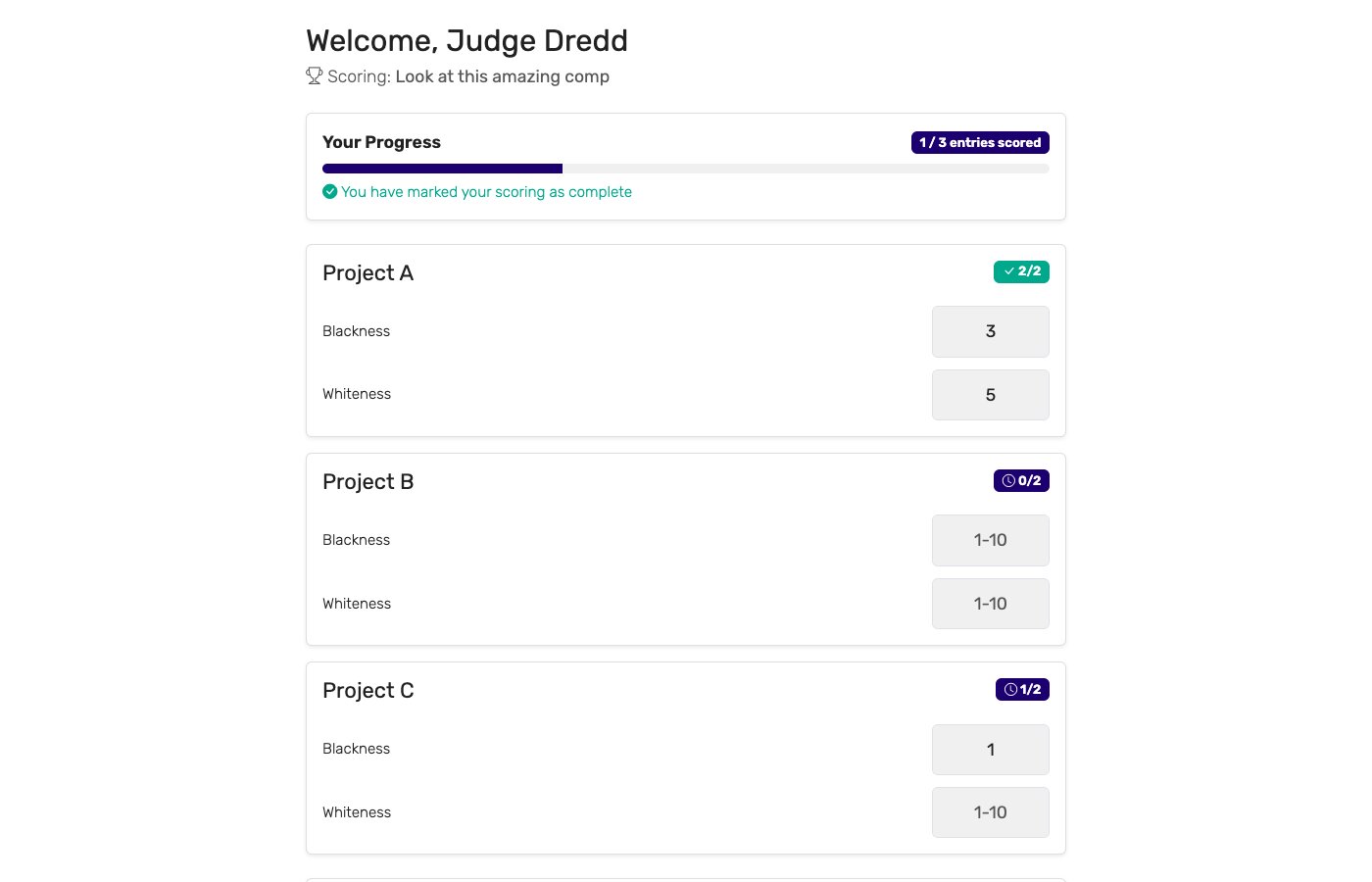
- Send each coach their link One private link per judge. No app to install, no account to create, nothing to set up on a borrowed school iPad — it opens in the browser.
- Score through the session Coaches score as candidates go, scrolling a single list. Scores save as they type. Judges can't see each other's scores or the leaderboard while they work.
- Read the ranking, then announce Keep results hidden until you're ready. The organiser view shows the full candidates-by-judges grid and the ranked list with every criterion broken out; export the whole thing to CSV for your records.
What it's used for
- Cheer and dance team tryouts at middle school, high school and college, including the callback round.
- Colorguard, winterguard and majorette auditions where equipment work and performance carry separate rows.
- Studio company and competition team auditions scored skill by skill as dancers go down the floor.
- Drill team and dance line selections with a large field and a short sheet.
- Sports team tryouts where a coaching staff scores the same drills across two or three sessions.
Who uses it
- Cheer and dance coaches running annual tryouts against a fixed roster size.
- Band and guard directors auditioning for the next competitive season.
- Studio owners placing dancers into company levels.
- Athletic directors who need a defensible record of how a roster was decided.
- Outside judges brought in for the day, who get a link and nothing else to learn.
Per-criterion maximums
Tumbling out of 10 and appearance out of 5 on the same sheet. Each criterion carries its own maximum, so weighting doesn't need mental arithmetic.
Drop high and low
Discard each candidate's highest and lowest judge score automatically. The outlier problem goes away without a discussion.
Judges score blind
A judge sees their own sheet and nothing else — not the other coaches' numbers, not the standings. No anchoring.
Hide results while you judge
Switch the public link to hidden and nothing shows on it until you flip it back. Announce the roster on your own terms, not as a live scoreboard in front of teenagers.
Private judge notes
Optional per-candidate notes, visible to the coach who wrote them and to you — never to the rest of the panel. The raw material for the feedback conversation with everyone who didn't make it.
CSV export
Every judge × candidate × criterion score in one file. This is what you open when a parent calls.
Tryouts sit above the free plan almost by definition — free covers 3 judges and 5 candidates, which is enough to try the thing out but not to run a squad selection. Plus is $19/month and covers up to 25 judges and 50 candidates, which fits most cheer and dance tryouts. A field bigger than 50 needs Pro at $39/month. Tryouts are a once-a-year event, so most coaches subscribe for the month it happens and cancel afterwards — see pricing.
Paper sheets vs. scoring on tablets
Paper is genuinely fine for a twelve-candidate studio audition with three judges. It stops being fine somewhere around the point where the tally takes longer than the tryout.
| Capability | Tablets | Printed sheets |
|---|---|---|
| Time to a ranked list | ✓ Instant | An hour or more with 5 judges × 40 candidates |
| Arithmetic errors | ✓ None | The thing that gets a roster reversed on Monday |
| Every judge on the identical rubric | ✓ Guaranteed | Until someone photocopies last year's version |
| Drop high/low per candidate | ✓ Automatic | Recalculated by hand, per candidate |
| Per-judge breakdown for a parent | ✓ Stored and exportable | A stack of paper in a coach's car |
| Judges scoring independently | ✓ Enforced — nobody sees another sheet | Depends on where you seat them |
| Works with no wifi | Scores save locally and sync on reconnect | ✓ Always |
| Cost | A month's subscription | Printing, plus two people tallying |
School gym wifi is the real risk, and we'd rather say so than pretend otherwise. Judge sheets autosave locally and retry when the connection comes back, so a dead spot costs you nothing — but if your gym has no signal at all, print the sheets and enter the numbers afterwards.
How to choose a tryout scoring tool
- Does it cover your panel and your field? Five judges and sixty candidates is 300 score entries. Check the limits before tryout day, not on it.
- Can judges score without an account? Outside judges will not create a login on a Saturday morning. A link is the only workable answer.
- Can you hide the results? A live leaderboard is right for a talent show and wrong for a tryout. You need to be able to switch the public view off before judging starts — and to remember to do it.
- Can criteria carry different weights? If tumbling matters more than appearance, the sheet has to say so numerically.
- Is there a per-judge audit trail? The whole point is being able to show your working afterwards.
- Does it work on whatever devices you have? Borrowed iPads, coaches' own phones, one ancient Android tablet. Browser-based beats an app install every time.
If your event is a competition rather than a selection — scoring routines against each other for placements — the sheets are different and so is the intent. See judging software for dance competitions for that side.
Print it, or score it live
The sheets above are yours — print them and run your tryout on paper if that's what fits. If five judges and forty candidates sounds like a long evening with a calculator, set the same rubric up once and get the ranking the moment the last coach hits submit.
Frequently asked questions
How do you score cheer tryouts?
Break the tryout into the things you actually watch — motions, jumps, tumbling, the cheer or chant, dance, showmanship, poise and coachability — and give each one its own score out of 5 or 10. Every judge scores every candidate on the same sheet, independently, without discussing scores first. Add the categories up per judge, then add the judges together. A candidate's place is the sum, not a show of hands at the end.
What is a good cheer tryout score?
There's no universal pass mark, because the scale is only meaningful inside your own tryout. On the eight-category sheet above (40 points per judge), returning members and strong newcomers usually land in the low-to-mid 30s, solid candidates in the mid-20s, and anyone below about 20 has a visible gap in a specific category. What matters is the ranking across your candidates, not hitting a number — decide the squad size first, then take the top N.
What criteria are used for dance team tryouts?
The rubric most dance teams run scores ten things out of 10 each: flexibility, turn technique, jump and leap technique, choreography, musicality and timing, retention and application, execution and cleanliness, performance quality, work ethic and attitude, and overall impression — 100 points per judge. Studio company auditions often replace the quality categories with one row per skill instead: double pirouette, center leaps, tilt jump, calypso, acro, special skill.
How many judges should score a tryout?
Three at minimum, five if you can get them. Three judges is enough for one generous or harsh scorer to be outweighed; with two, a disagreement is a coin flip. Five and above lets you drop each candidate's highest and lowest score, which removes an outlier without anyone having to argue about it. Across the tryouts and auditions run on ScoreJudge, five judges is the most common panel size.
How do you keep a tryout fair when the judges know the candidates?
Use outside judges wherever you can — coaches from another school, alumni, a studio owner from the next town. Where that's not possible: give candidates numbers instead of names, keep judges from seeing each other's scores while they score, write down what each score level means before the tryout starts, and drop each candidate's highest and lowest score. Then keep the per-judge breakdown. Almost every contested tryout result is settled by being able to show a parent the actual numbers.
Should you show tryout scores to candidates and parents?
Publish the roster, not the leaderboard. A live public ranking during a tryout is tough on teenagers and invites comparison between candidates who didn't make it. Keep scores hidden while judging is underway, announce the team, and then share a candidate's own scores privately with them or their parents on request. ScoreJudge has a hidden visibility mode for exactly this: the panel and organiser see everything, the public link shows nothing until you choose to reveal it.