How to Run a Hobby Horse Competition (2026 Guide)
Classes, score sheets and judging rules for a hobby horse competition, from a pony club fun day to a club championship with three judges.
Article Contents
Twenty riders, a hall full of parents, and a stack of paper score sheets that nobody can add up fast enough. That's how most first hobby horse competitions go. The riding is the easy part. The judging is where it falls apart.
This guide covers what to judge, how to score it, and how to get results out before the kids lose interest. It works for a pony club fun day or a club championship with three judges.
Pick Three Classes, Not Six
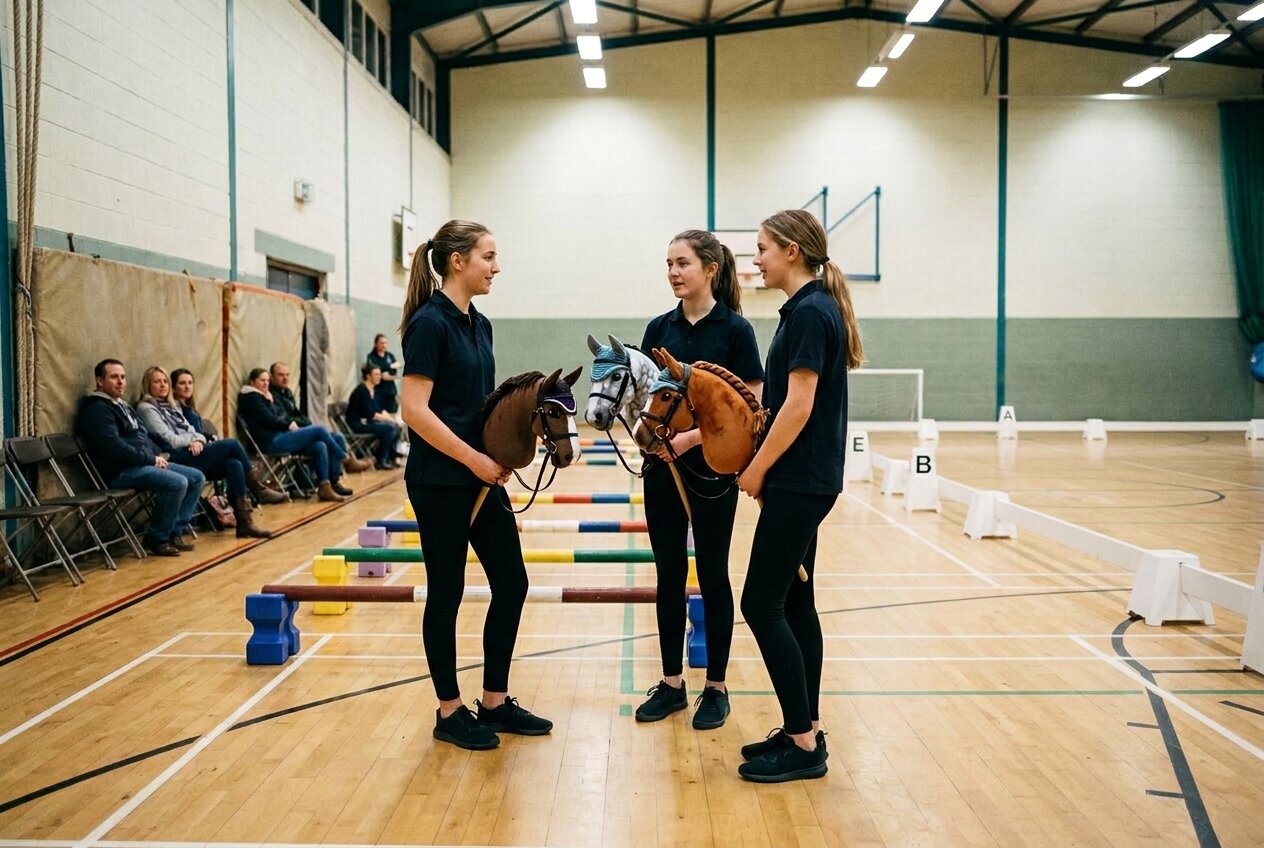
Hobby horsing borrows its classes from real equestrian sport. The Finnish Hobbyhorse Championships in Seinäjoki, the biggest event in the sport, run dressage, show jumping, freestyle and a show class for the horses themselves. In 2024 it drew 260 riders from 22 countries.
You don't need all of that. For a first competition, run three classes:
- Dressage. A short test ridden from memory or read aloud. Judged on marks.
- Show jumping. A small course of fences. Judged on faults and time.
- Best horse. The hobby horses themselves are judged on how they're made and turned out.
The third one matters more than it looks. Many riders sew their own horses, and a well-made head is a real piece of craft. A class that rewards the craft gives riders who aren't confident jumpers something to win. It also keeps younger kids busy while the older ones ride.
Freestyle (a dressage routine set to music) is great to watch, but it's a lot to judge. Add it once you've run the basics once.
How Hobby Horse Dressage Is Scored
Use the same system as horse dressage. The British Hobbyhorse Association handbook sets it out clearly:
- Judges give each movement a mark from 0 to 10. Half marks are allowed.
- Collective marks at the end cover the whole ride, such as rhythm, accuracy and the rider's position.
- All marks are added together, then penalties come off.
- An error of course (a wrong turn or a missed movement) costs 2 points the first time and 4 points the second time. The third one means elimination.
The judge sits at the letter C, at the short end of the arena. At a championship, two more judges sit at B and E, the middle of each long side. Then the final score is all the judges' marks added up and turned into a percentage.
Here's a simple score sheet for a beginner test. Copy it, change the movements to match your test, and print one per rider:
| # | Movement | Mark (0–10) | Judge's comment |
|---|---|---|---|
| 1 | Enter at A in working trot, halt at X, salute | ||
| 2 | Track right, working trot circle at B | ||
| 3 | Change rein across the diagonal | ||
| 4 | Working canter circle at E | ||
| 5 | Free walk across the diagonal | ||
| 6 | Halt at X, salute | ||
| 7 | Rhythm and energy (collective) | ||
| 8 | Accuracy of figures (collective) | ||
| 9 | Rider's position (collective) | ||
| Errors of course (−2, −4) | |||
| Total | / 90 |
Keep beginner tests short. Six movements and three collective marks are enough for a judge to see what a rider can do, and short enough that twenty riders finish before lunch.
One rule worth copying from the BHHA: riders may have their test read aloud, except in championship classes. For under-10s this is the difference between a ride and a meltdown.
Show Jumping: Faults First, Then the Clock
Jumping is the easiest class to judge because it barely needs judgment. Count the faults, time the round, and rank riders by faults first and time second.
Knocking down a pole or refusing a fence costs faults. How many is up to you, but write it on the entry form so nobody argues about it afterwards.
Fence heights are the thing to get right. At the Finnish Championships, the top classes jump up to 110 centimetres, which takes serious athleticism. Your club show doesn't need that. Set a low course for the youngest group and raise it by age group. Offer a clear-round class where anyone who jumps clear gets a rosette, whatever their time.
Two practical tips:
- Put one person on the stopwatch and nothing else. Timing and fault-counting from the same chair goes wrong.
- Hobby horse fences get knocked by feet, not hooves. Poles on shallow cups fall easily, so check your fences before the first rider goes.
Judging the Horses Themselves
The best-horse class is where you need a proper rubric, because "which one is nicest" is how you end up with a crying eight-year-old and an angry parent.
Score each horse on three or four criteria, 1 to 10 each:
- Craftsmanship. Neat stitching, a head that holds its shape, a secure stick.
- Realism. Does it look like a real breed? Eyes, nostrils, mane and ear placement.
- Turnout. Bridle, ear bonnet, mane plaits, overall presentation.
- Creativity. A fantasy colour or an unusual design, done well.
Tell riders the criteria before the day. It's fairer, and it gives them something to work on at home. If a parent obviously made the horse, that's fine, but consider a separate "made by the rider" class for older kids.
How Many Judges Do You Need?
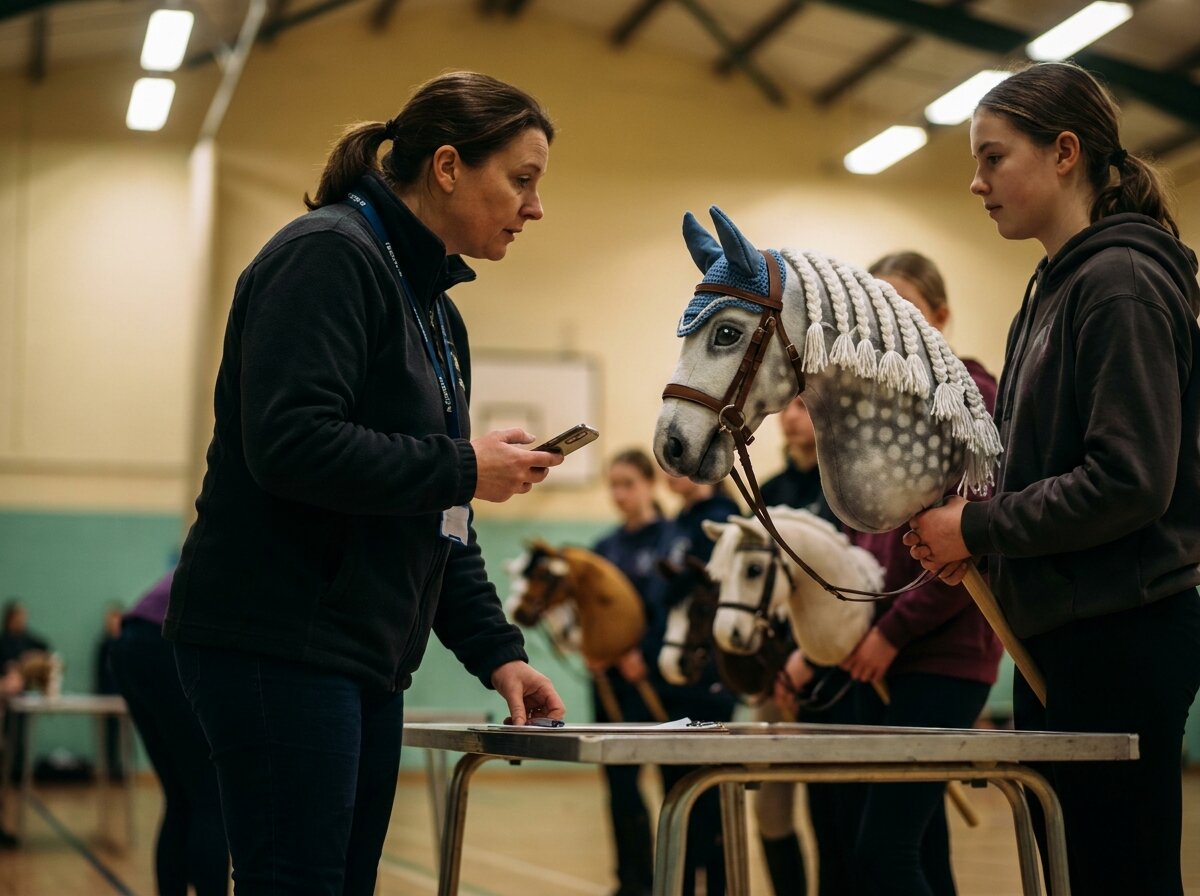
For a fun day, one judge per class is enough. For anything with a trophy, use at least two for dressage and the best-horse class. One judge's taste is a coin flip. Two or three averaged out is a result people accept.
Your judges don't need to be dressage professionals. A riding instructor, an older rider from another club, or a parent who rides will do fine, as long as they all use the same score sheet. Brief them together for ten minutes before the first ride. Agree what a 5 means and what a 9 means. That conversation does more for fairness than any rulebook. We wrote more about this in how to judge a competition fairly.
Keep judges away from their own club's riders if you can. If you can't, a panel of three with the highest and lowest score dropped takes most of the bias out.
Getting Results Out Quickly
Paper works, but adding up nine marks per rider across three judges, then working out percentages, is where most shows lose an hour. Results arrive after half the families have gone home.
Score Judge replaces the paper sheets. Each judge scores on their own phone, the marks add up as they go in, and the ranking is live the moment the last rider finishes. You can put dressage and the best-horse class in one competition, each with its own criteria, and give each judge only the classes they're judging. Judges can leave a private note per rider too, and those notes appear in your export.
Be aware of what it doesn't do. Score Judge adds up raw marks and can average them across judges, but it doesn't turn a dressage score into a percentage, and it has no way to count one movement double. For a club show that's fine: the ranking comes out the same when every rider rides the same test. Jumping doesn't need Score Judge at all. A stopwatch and a clipboard do the job.
If you're running more than one judge, see how scoring with multiple judges works before the day.

Written by Caspar von Wrede
Founder of Score Judge. Building tools for real-time competition judging at live events.